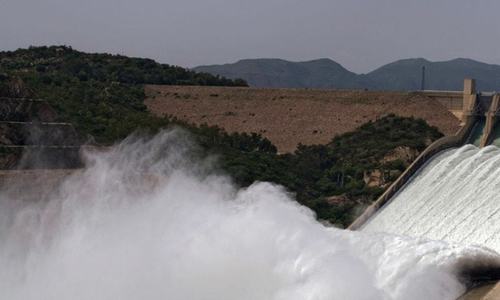
9-member Indian delegation reaches Lahore for two-day water talks with Pakistan



A nine-member Indian delegation arrived in Lahore on Tuesday for two-day Pakistan-India Permanent Indus Commission talks scheduled for August 29-30.
Led by Indian Water Commissioner P K Saxena, the delegation reached the provincial capital through Wagah border for the talks starting tomorrow.
Pakistan Water Commissioner Syed Mehr Ali Shah, who welcomed the Indian delegation at the border, will lead his side during the discussions that will take place at the Lahore headquarters of the National Engineering Services of Pakistan (Nespak).
During the two-day talks, Pakistan will reiterate its serious objections over two controversial water storage and hydropower projects being built by India, Dawn reported on Monday.
A government official said Pakistan will raise its concerns over the construction of 1000MW Pakal Dul and 48MW Lower Kalnai hydroelectric projects on River Chenab despite Islamabad’s serious objections over their designs.
Pakistan has been raising reservations over the designs of the two projects and would like India to either modify the designs to make them compliant to the 1960 Indus Waters Treaty or put the projects on hold until Delhi satisfies Islamabad.
The two sides will also finalise the schedule of future meetings of the Permanent Indus Commission and visits of the teams of the Indus commissioners. The water commissioners of Pakistan and India are required to meet twice a year and arrange technical visits to projects’ sites and critical river head works, but Pakistan has been facing a lot of problems in timely meetings and visits, the official told Dawn.
The two-day session is also expected to discuss ways and means for timely and smooth sharing of hydrological data on shared rivers.
Pakistan's concerns
Both projects — Pakal Dul and Lower Kalnai — are on two different tributaries of Chenab river. India had promised in March last year to modify the designs of the two projects and address Pakistan’s concerns but in vain.
Instead, Prime Minister Narendra Modi laid the foundation stone of 1000MW Pakal Dul project in May this year to kickstart the project, without addressing Islamabad’s reservations. According to Indian media reports, the project’s completion is targeted within 66 months with a commitment to provide 12 per cent free of cost electricity to India-held Jammu and Kashmir.
A former water sector official said it was typical Indian style to build projects in violation of the 1960 treaty as was evident from all previous controversial projects like Baglihar and Kishanganga. During execution of these projects, New Delhi engaged Islamabad in technicalities, but kept civil and side works moving for years until reaching the fait accompli stage, when challenged at international forums.
Pakistan has objections to the pondage and freeboard of Lower Kalnai and pondage, filling criteria and spillway of Pakal Dul hydropower projects on Marusadar River — a right bank tributary of the Chenab.
Pakal Dul is a storage-cum-power project and can have gross storage of about 108,000 acre feet of water. The project design envisages its filling every monsoon season between mid-June and end-August.
Pakistan is of the opinion that the tunnel spillway of Pakal Dul should be raised closer to the dead storage level because its placement 40 metres below the dead storage level could allow drawdown flushing not permitted to India under the 1960 water treaty.
Pakal Dul dam-cum-hydropower project is three times larger than Kishanganga Hydroelectric Project that Pakistan believes has been built in violation of the treaty. Islamabad is seeking international arbitration without success at the level of intransigent World Bank administration.
On the 48MW Lower Kalnai project, Pakistan has raised objections to its freeboard, pondage and intake and is of the view that the depth of bridge girder and provision of freeboard should be close to one metre and considers two-metre freeboard as ‘excessive’.
Pakistan has also challenged the discharge series of River Lower Kalnai at Dunadi for winter months and estimated permissible pondage of 0.38 cubic megametres compared to Indian design pondage of 2.74 cubic megametres.
The Lower Kalnai project is on a left bank tributary of Chenab and can have gross storage of about 1,508 acre feet of water.
Under the provisions of the Indus Waters Treaty 1960, waters of the eastern rivers — Sutlej, Beas and Ravi — had been allocated to India and the western rivers — the Indus, Jhelum and Chenab — to Pakistan, except for certain non-consumptive uses for India.