1
1

KARACHI: Pakistan is facing external pressures rising from increasing imports of capital goods as well as investments under the China-Pakistan Economic Corridor (CPEC), said Moody’s, the international ratings agency, on Friday. Moody’s issued its view on Pakistan’s economy and analysed that the external pressure has been continually mounting which may further aggravate the issue of declining foreign exchange reserves.
The record current account deficit of $18 billion in FY18 has eroded foreign exchange reserves of the country hampering its ability to meet external obligations.
The newly elected government has shown its willingness to approach International Monetary Fund (IMF) for a bailout package but at the same time it is also considering other options like borrowing from China and Chinese banks.
Country’s imports, which have become a grave concern for the economy, could not be curtailed despite numerous of steps taken by previous government as well the caretaker government to halt the widening trade deficit.
“Pakistan is facing pressures owing to import of capital goods rising from domestic demand,” said Moody’s adding that the imports are higher because of heavy investments related to CPEC.
CPEC related investments have become one of the major contributors to the perennially increasing imports bill. Pakistan has a $56bn agreement with China, which will be invested in multiple infrastructure, energy and communication projects.
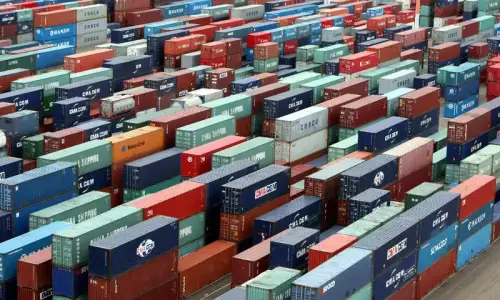
Of the total $55.85bn imports, China continues to hold top spot at the list of countries with highest exports to Pakistan, with total bill from the Asian giant reaching $11.45bn during FY18. Following that, imports from United Arab Emirates (UAE), which have crossed the $9bn mark, have also propped up country’s import bill. Imports from UAE, unlike China, do not include capital goods.
According to a State Bank report, total import bill was much higher since the import of services in FY18 also reached $10.49bn taking the total import bill as high as $66.3bn.
However, Moody’s said the current account deficit is likely to settle lower at 4.8pc of gross domestic product (GDP) during FY19 down from 5.7pc recorded during the FY18, hinting at a decline in deficit.
In Moody’s view, the foreign reserve coverage of external debt repayments remains adequate; however, the coverage for external debt might weaken in medium-term. The country has been paying heavy cost of external borrowing as it had to pay $7.5bn in FY18 as debt servicing.
Rise in foreign exchange reserves is possible through and in combination with an IMF program, said Moody’s. The rating agency forewarns risk of deeper erosion in reserves during the current fiscal year.
The State Bank’s reserves decreased by $5.1bn in FY18 falling to $9.5bn in July 2018 from $14.58bn in July 2017.
Moody’s said that around one-third of government debt is denominated in foreign currency and is exposed to currency risk since slight depreciation could raise inflation. During FY18, PKR went through three bouts of depreciation, collectively taking the currency down 20pc against the greenback. But, Rupee has appreciated more than 4pc ever since the new government took reins inculcating a degree of confidence in the economy.
Moody’s warned that any prompt hike in policy rate can increase overall borrowing costs. The State Bank in its last monetary policy decision on July 14, had increased interest rate by 100 basis points to 7.5pc in a bid to cool down the heating economy and control rising inflation.
“This act could further weaken the government’s fragile fiscal position,” said Moody’s.
“Pakistan’s debt affordability would weaken significantly from already low levels in the event of a sharp and sustained increase in the cost of debt,” said Moody’s view on Pakistan. It also emphasised the need to increase in capital inflows in order to help the overall health of the economy.
Published in Dawn, August 25th, 2018