IT was over a decade ago that I first heard about sex grooming gangs. Through a report on Channel 4 News, I learned how young men of Pakistani origin were sexually exploiting vulnerable, under-age white girls after plying them with cigarettes, alcohol and gifts.
I was offended by the use of “Pakistanis” and “Muslims”, believing that it was wrong for a mainstream broadcaster to narrow down so much on a group of people based on their country of origin or religion. In my view, Channel 4 News should have concentrated on reporting child sex grooming as any other crime.
Take a look: Rochdale grooming gang members to be stripped of UK citizenship, face deportation to Pakistan
Later, when more cases came to light, it dawned on me that the sections of British media describing the perpetrators as “Pakistanis” were not that off the mark.
According to a study conducted by the Quilliam Foundation, an anti-extremism think tank, 84 per cent of all those convicted of child sex grooming since 2005 have been Asian; the majority were of Pakistani heritage. Quilliam’s researchers found that 264 people have been convicted for the specific crime of gang grooming since 2005; 222 of them were Asian.
The report’s co-author, Haras Rafiq, is himself from Rochdale, a town where members of a sex ring of predominantly British-Pakistani men were jailed in 2012.
“I’m from the heart of where one of the highest-profile cases have occurred over the last few years,” he told Sky News last year. “And I’m saying it’s very important that we do talk about it because the problem won’t go away. We didn’t want there to be a pattern of people from our ethnic demographic carrying out these attacks. But, unfortunately, we were proven wrong.”
When you try to discuss this with a community leader, you encounter a wall of silence: “Should we really talk about it when there are so many other negative headlines around?” I was asked in Sheffield. “This will be exploited by the far right and bring a bad name to the community.”
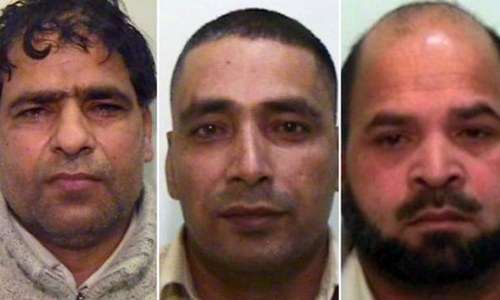
The appeals of three members of the Rochdale gang against the UK Home Office’s decision to revoke their British citizenship have recently been rejected by the Court of Appeal, clearing the way for their possible deportation to Pakistan.
Abdul Aziz, Adil Khan and Qari Abdul Rauf were convicted in 2012 and were informed by the Home Office in 2015 that they would be stripped of citizenship. They challenged the decision on the grounds that it breached their human rights.
However, two levels of immigration tribunal rejected their arguments, with the first-tier tribunal (FTT) declaring that the consequences for the men and their families did not outweigh the public interest in ending their British citizenship. It was against the decision of the FTT that the trio had moved the Court of Appeal.
But Lord Justice Sales and two other judges ruled that both levels of tribunal had made a proper and lawful assessment.
Lord Justice Sales ruled: “Given the extremely serious nature of the offence by each appellant, there is no good ground for calling that conclusion into question. There was no error of law by the FTT,” adding that if the Home Office decided to deport the men, each would have the right to appeal.
Adil Khan, 42, a taxi driver originally from Sehnsa in Azad Jammu & Kashmir (AJK), was found guilty of trafficking and conspiracy to engage in sexual activity with a child. He came to Rochdale from Kashmir with his wife in 1997 and had a sexual relationship with a young girl just a few weeks after the birth of his first child. The court heard that he made a 15-year-old girl pregnant, then passed another girl of the same age on to other men for sex, threatening her with violence.
Abdul Aziz, 41, another taxi driver from Panyam, Chakswari in AJK, and father of three, was cleared of two counts of rape but convicted of trafficking for sexual exploitation.
Qari Abdul Rauf, 43, father of five from AJK was convicted of trafficking a child within the UK for sexual exploitation. The former religious studies teacher at a Rochdale mosque said he was deeply religious.
Shabbir Ahmed, 63, the ringleader, was not amongst those who appealed against the Home Office’s decision to strip them of British nationality. The three-times married, father of four, first came to Britain from Pakistan in 1967 when he was 14 years old. In an earlier appeal hearing, the Home Office maintained that he was a British citizen but would not be rendered stateless if he was stripped of UK citizenship since he retains Pakistani nationality.
The orders to revoke the citizenship of the Rochdale gang members were issued under a law that allows the authorities to deny a person their British citizenship if the Home Secretary is satisfied that “it would be conducive to the public good to deprive the person of their British citizenship status and to do so would not render them stateless.”
These powers were initially used to strip those accused of terrorism of their British citizenship but later extended to cover child sex grooming convicts. This shows not only the severity being attached by the government to this offence but also the public mood towards the perpetrators.
Published in Dawn, August 21st, 2018