WASHINGTON: US President Donald Trump said on Saturday he condemns “all types of racism and acts of violence”, appealing for unity ahead of the anniversary of a deadly white nationalist rally in Charlottesville.
Trump drew strong criticism in the days after the Charlottesville rally last year for equating white supremacists with counter-protesters and saying “both sides” were to blame.
On Saturday, Trump wrote on Twitter that the “riots” in Charlottesville “resulted in senseless death and division. We must come together as a nation. I condemn all types of racism and acts of violence. Peace to ALL Americans!”
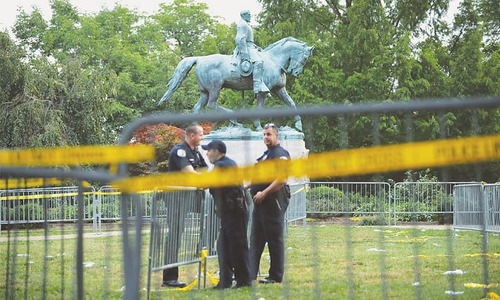
White nationalists held a “Unite the Right” rally in Charlottesville last year, billing it as a protest over the removal of a statue honoring a commander of the Confederate Army, the losing side in the US Civil War.
Counter-protesters turned out to demonstrate against the rally. James Alex Fields, Jr. is charged with driving his car into a group of counter-protesters, killing 32-year-old Heather Heyer and injuring dozens of people. He has pleaded not guilty and his trial is set to begin in November.
The organiser of last year’s event, white nationalist Jason Kessler, was denied a permit in Charlottesville this year but has secured permission to hold a demonstration on Sunday in Washington, across the street from the White House.
Officials have declared states of emergency for both the city of Charlottesville and the state of Virginia to help law enforcement mobilize state and local resources for security reasons.
Images circulating on social media showed a heavy security presence in the city, where concrete barricades and official cars encircled the downtown, with just two entry points for pedestrians.
The violence culminated with a man driving a car into a crowd of counter-protesters, killing a woman and injuring 19 people.
In the immediate aftermath, Trump drew broad criticism when he initially appeared to establish a moral equivalence between the two groups of protesters and refused to criticize the far rightwingers. He did eventually yield to immense political pressure and condemn white nationalism.
But just a day later, Trump said there was “blame on both sides” for the violence in Virginia, condemning the anti-fascists who came “with clubs in their hands.” “I think there’s blame on both sides,” Trump said. “But you also had people that were very fine people, on both sides.” Trump is constantly fending off charges that he is misogynist and racist.
He denies the allegations.
Published in Dawn, August 12th, 2018