ISLAMABAD: The Ministry of Foreign Affairs on Sunday announced the launch of Pakistan’s indigenously developed 285kg PakTES-1A observatory satellite in July.
Fitted with sensors and cameras, PakTES-1A will remain stationary 610km in space and its position relative to the sun will not change.
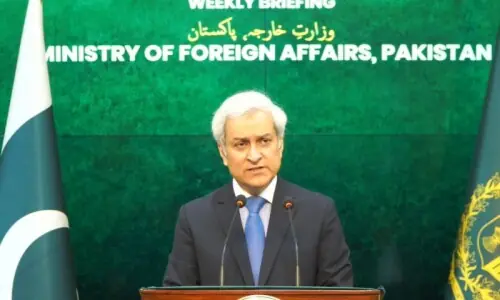
Foreign Office spokesman Dr Muhammad Faisal congratulated Pakistani scientists in a tweet, saying they had made Pakistanis proud.
Known as the Remote Sensing Satellite (RSS) it can be used to study various features of Earth, determine mineral deposits, and depending on the kinds of sensors and gadgets fitted, the RSS technology can also help study impacts of climate change such as recession of melting glaciers, green house gasses, detect forest fires and even solve problems related to agriculture as well as forestry, besides a whole range of passive and active tasks.
The Ministry of Foreign Affairs makes the announcement
The navigation technology for the satellite was acquired from China back in 2012.
Upon contact, both the Inter-Services Public Relations (ISPR) and the national space agency, the Pakistan Space and Upper Atmosphere Research Commission (Suparco), were hesitant to share details of this positive development.
India has been launching such observatory satellite since the 1970s.
However, former minister for science and technology Dr Attaur Rehman was forthcoming in his comments and also congratulated Pakistani scientists, calling the launch of the RSS next month a proud moment and a positive step that scientists have been able to develop and launch its satellite.
“Unlike the complex, heavier and bigger communication satellites, observatory satellite is a simple technology and can be used for a range of purposes depending on the types of sensing equipment it comes fitted with because there are various kinds of remote sensing satellites. It can also study electromagnetic waves and radiation emitted from Earth,” Dr Rehman said.
According to him, Pakistan is way behind in the region in launching satellites into space and at least 25 to 30 years behind India.
Published in Dawn, June 25th, 2018