Shahbaz told to recover entire public money paid to CEOs



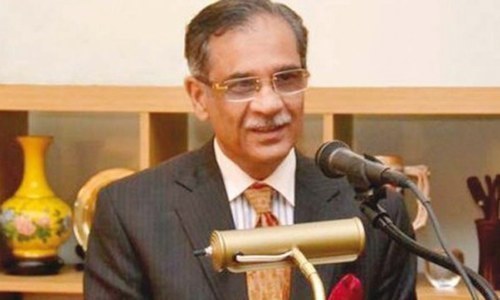
LAHORE: Chief Justice of Pakistan Mian Saqib Nisar on Sunday rejected an explanation given by Punjab Chief Minister Shahbaz Sharif for hiring the heads of 56 public sector companies and payment of high salaries to them.
The CJP directed Mr Sharif, who is also president of the Pakistan Muslim League-Nawaz, to recover the entire public money from the heads of the public sector companies or face court proceedings.
A two-member Supreme Court bench was hearing a suo motu case regarding the appointment of a retired officer as head of the Strategic Management and Internal Policy Unit on a remuneration package that was much higher than that of the Punjab chief secretary. “We are not satisfied with your answer. Why the CEOs are getting Rs2.5 million or Rs3 million as salary and under which law?” the CJP asked the chief minister.
CJP rejects CM’s explanation on public sector companies
Mr Sharif, who seemed emotional during the almost half-an-hour-long proceedings, replied: “I saved Rs170 billion [in different projects] but we are not appreciated. I am not bitten by a mad dog to save such an amount.”
As the CJP expressed dismay at the use of these words, Mr Sharif tendered an apology and said he should not have used such a language. “I’m sorry sir... my Lord.”
When he claimed he had never approved of the salaries, the CJP asked: “Just tell us how their salaries were approved. It is a simple question.”
CJP Nisar then reminded Mr Sharif that it was a serious issue and that he should take it seriously. “It’s a matter of public money. We will get it back,” he said.
Responding to the CJP’s remarks, Mr Sharif said: “Whatever judgement you give we will follow it.”
The chief justice told him that he would have to comply with it. “You have been chief minister for the last 10 years and what you have delivered? We want this money back,” he reiterated.
Mr Sharif responded: “Okay my lord you may order.”
As the other bench member, Justice Ijazul Ahsan, observed that NAB investigation had found corruption in the public sector companies, Mr Sharif said the bureau being an independent department should come up with clear evidence.
Earlier during the day, the CJP asked NAB to estimate the value of properties owned by the 56 chief executive officers.
The advocate general of Punjab told the court that the chief minister had no direct connection with the companies. The chief justice, however, rejected the argument, saying that “even a fly cannot move in the province without his involvement”, and directed the advocate general to approach the CM and ask him where he was and when he could appear before the bench.
Subsequently, the court was told that the chief minister would appear before it at 2pm.
Published in Dawn, June 4th, 2018