Pakistani prisons house 57pc more inmates than authorised capacity: report


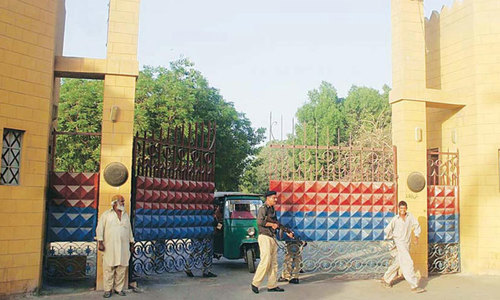
ISLAMABAD: Pakistan’s prisons house 57pc more prisoners than their authorised capacity, and two thirds of the total prison population is either awaiting or undergoing trial, as compared to 27pc at the international level, a report revealed on Tuesday.
The report, titled Addressing Overcrowding in Prisons by Reducing Pre-Conviction Detention in Pakistan and prepared by the National Counter Terrorism Authority (Nacta), International Committee of the Red Cross (ICRC) and Cursor Development and Education (Code) Pakistan, added that the situation is causing overcrowding in prisons and often results in deplorable living conditions for inmates and prison staff, the spread of disease and other problems.
The report divided its recommendations into urgent, short-term and long-term.
Says two thirds of prison population awaiting or undergoing trial
In order to prevent a major health crisis in Pakistan’s eight most overcrowded prisons – which exhibit an occupancy rate that is 300pc to 500pc higher than official capacity – the report recommended an urgent prison assessment to ensure prisoners’ quarters are well-ventilated and receive 10 to 15 litres of water per prisoner per day.
The report also recommended access at all times to drinking water stored in appropriate containers, a balanced diet consisting of food sufficient in quantity and quality prepared in accordance with hygiene standards, a sufficient number of toilets, access to open air during the day, medical care and the presence of emergency evacuation. Monitoring should also be carried out in real time due to fluctuations in the prison population.
In the long-term, the report recommended sufficient support to reduce socioeconomic marginalisation – which may include social welfare assistance, support for housing, employment and so on. It also suggested reviewing the age of criminal responsibility to protect children. In the short-term, the report said special efforts should be made to keep women and children away from pre-conviction detention.
Nacta Coordinator Ihsan Ghani Khan said at the launch of the report that it was unfortunate that people spend decades in prison before they are convicted or proven innocent.
“How would it feel if the same thing happened to any one of us? Here, 66pc of prisoners are in jails without conviction, as compared to the international rate of 27pc. Nacta has proposed carrying out research so people are not detained unnecessarily. We will continue working on the issue of prisoners and will implement the report, rather than allowing it to gather dusk on the shelf,” he said.
Law and Justice Commission of Pakistan Secretary Dr Mohammad Raheem Awan said the commission was compiling data on prisons and working to complete criminal hearings.
“There is no pendency of criminal cases in the Supreme Court’s Karachi and Quetta registries, and there are only 225 cases in Islamabad. Even that pendency will end in August this year. However, as many as 72 reports by the commission are pending with the government and could not be implemented,” he said.
Mr Awan said efforts were being made to decide cases under alternate dispute resolution. He said each civil magistrate in Pakistan hears 200 cases per day, which is not possible anywhere in the world. However, he said, the rate of announcing decisions in three times higher in Pakistan compared to other countries in the region.
ICRC head Reto A. Stocker said prison overcrowding cases physical and mental problems for prisoners because they were facing continuous unrest. He said a broad-range response was required from all the stakeholders to address the issue.
Code President Dilawar Khan said problems in the criminal justice system needed to be addressed.
Mr Khan told Dawn that while prisoners do not get adequate floor space in prisons, the law requiring prisoners to have a room 14x16ft of space was unrealistic and would not even be possible in developed countries.
“We have suggested a number of times that the law – rule 745 – regarding jails should be revised, but it could not be,” he said.
Published in Dawn, May 9th, 2018