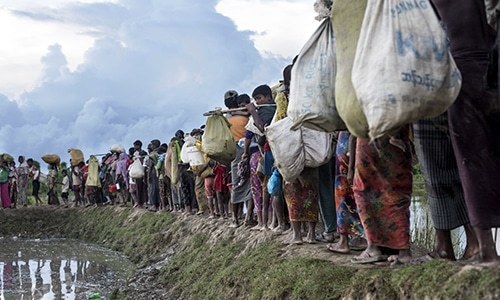
COX’S BAZAR: A UN Security Council delegation arrived in Bangladesh on Saturday to get a firsthand look at the plight of some 700,000 Rohingya Muslims who have fled Myanmar to escape military-led violence.
The team will visit camps housing the refugees and discuss the crisis with local officials. The delegation will also visit Myanmar after concluding its three-day visit on Monday.
Representatives from the five permanent Security Council members China, France, the Russian Federation, the United Kingdom and the United States and 10 non-permanent member states have joined the delegation, which arrived in the coastal town of Cox’s Bazar, where the camps are located.
The recent spasm of violence in Myanmar began when Rohingya insurgents staged a series of attacks on Aug 25 on about 30 security outposts and other targets. In a subsequent crackdown described by the United Nations and the United States as “ethnic cleansing”, Myanmar security forces have been accused of rape, killing, torture and the burning of Rohingya villagers’ homes.
Bangladesh’s acting foreign secretary, M. Khurshed Alam, said the delegation’s visit is “very significant”, with international pressure on Myanmar continuing to mount to ensure the safe and voluntary return of the refugees, who are seeking protection from the United Nations.
“This council can make a difference by putting pressure on Myanmar and creating a situation to start the repatriation in full swing. It has that influence,” Alam said.
Britain’s U.N. ambassador, Karen Pierce, said in New York that the most important thing is that the body charged with maintaining international peace and security “can see for itself the situation on the ground in a very desperate case of alleged human rights violations and abuses and crimes against humanity”.
Lord Nazir Ahmed, the United Kingdom’s minister of state for the Commonwealth and the United Nations, told reporters earlier in the week that Myanmar’s agreement to the council visit and a previous visit by the U.N. special envoy for sexual violence in conflict “demonstrates the glimmer of hope in what has been a very dark chapter in human history in that part of the region”.
He stressed the importance of direct engagement, which “sends a very strong signal to those in Myanmar, both the civilian but more importantly military authorities who have been responsible largely for what we’ve seen, which has been ethnic cleansing and nothing short of that”.
Bangladesh and Myanmar agreed in December to begin repatriating the refugees in January, but there were concerns among aid workers and Rohingya that they would be forced to return and face unsafe conditions in Myanmar.
Thousands flee fresh clashes
Thousands of people have fled renewed fighting between Myanmar’s army and ethnic insurgents in the country’s remote north, a United Nations official said, as a long-simmering conflict intensifies.
More than 4,000 people have been displaced in the country’s northernmost state of Kachin near the border with China in the last three weeks, Mark Cutts, head of the UN’s Office for the Coordination of Humanitarian Affairs (OCHA), told AFP late Friday.
The numbers do not include some 15,000 people who have fled since the beginning of the year, and upwards of 90,000 residing in IDP (internally displaced persons) camps in both Kachin and Shan states since a ceasefire between the government and the powerful Kachin Independence Army broke down in 2011.
“We have received reports from local organisations saying that there are still many civilians who remain trapped in conflict-affected areas,” Cutts said of the recent clashes.
“Our biggest concern is for the safety of civilians — including pregnant women, the elderly, small children and people with disabilities. We must ensure that these people are protected.” OCHA has been unable to verify reports that civilians have been killed in the fighting. A Myanmar government spokesman could not be reached for comment.
Published in Dawn, April 29th, 2018