14
14

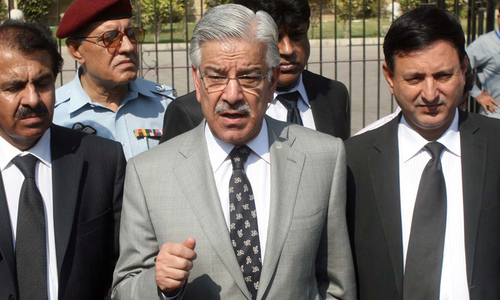
ISLAMABAD: Though a three-member bench of the Islamabad High Court disqualified Foreign Minister Khawaja Asif on a petition of a Pakistan Tehreek-i-Insaf leader on Thursday, the court verdict advised lawmakers to settle such disputes on their own as this sort of litigation unnecessarily dragged courts in controversies.
The bench in its concluding note stated, “when political forces, instead of settling disputes at the political forums, particularly the Majlis-i-Shoora (Parliament) resort to the Courts, it has consequences not only for the institutions but the litigant public as well. This conduct of political forces lowers public confidence in the Legislature on the one hand and on the other hand exposes the institution of the judiciary to the controversies of adversarial politics. The political forces are expected to settle their grievances before the political forums rather than taking the precious time of the bona fide litigants awaiting justice to be dispensed.”
Read: IHC sends Asif packing with ‘a heavy heart’
It said that parliament, which was a symbol of unity of the federation and the people’s will, deserved the utmost respect, adding that its prestige and public confidence depended on the conduct of its members who represented the actual stakeholders i.e. the people of Pakistan.
Such litigation unnecessarily drags courts in controversies, three-judge bench says in verdict about Khawaja Asif’s disqualification
The bench observed that it would have been appropriate if the political party to which the petitioner belonged had raised the issue in parliament before invoking the jurisdiction of the court.
It termed the act of disqualifying Khawaja Asif “not a pleasant duty” stating “we have handed down this judgment with a heavy heart not only because a seasoned and accomplished political figure stands disqualified but more so because the dreams and aspirations of 342,125 registered voters have suffered a setback”.
The concluding note quoted a paragraph of the judgement of Justice Hamoodur Rehman that states, “While exercising power of judicial review, the judiciary claims no supremacy over the (state) organs and that it is a duty assigned to the courts to see that the constitution prevails.”
Published in Dawn, April 27th, 2018