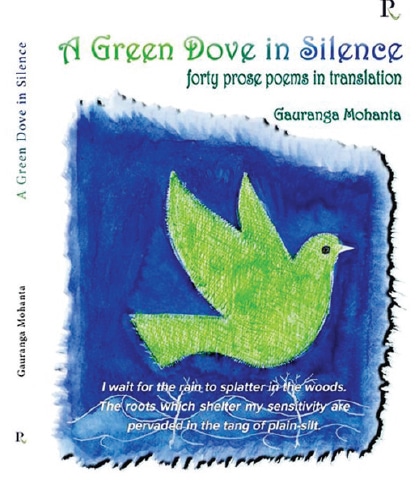
There is a feel good factor about Gauranga Mohanta’s collection of prose poems A Green Dove in Silence: Forty Prose Poems in Translation.
A neat jacket, crispy pages, lucid translation, handy size, hardbound — everything about the book, including the stated hybridised form of prose-poems highlighted in the colour-coded title, seem fresh.
The poems read like prose; well they in their justified block paragraphs even look like prose. The absence of versification, however, does not make them any lesser poems. Prose-poets, if there is any such label, have all poetic raw materials in their arsenal: symbols, metaphors and metonymies, images, alliteration, pun, allusion and the rest of the figures of speech. Practitioners of prose poems push the limit of poetry by exploring human consciousness without positing it as a metrical composition.
Such experiments can be traced back to 19th century France when figures such as Aloysius Bertrand, Baudelaire, Mallarme, and Rilke were busy capturing the ephemeral, fugitive contingency in art through a momentary experience that is not constrained to its given moment.
Prose poems became particularly popular among some American writers as David Lehman in his 2003 anthology of prose poems has shown. Lehman includes even works of Emerson and Poe as prose poems.
Tagore toyed with the idea in his Lipika, but was hesitant to call them poems.
Perhaps the most obvious instance of prose poems that my generation grew up with is Khalil Gibran’s The Prophet. Gibran’s reflection on his loneliness as an immigrant in the US forces him to paint his emotions in words. Prose poems, by design, are primarily about seeing and feeling.
Gauranga Mohanta tries to do the same. He wants us to take pulse of the universe with some chosen images. All the 40 poems have been translated from Bangla; the poet himself has translated 13 of them. The first piece describes the encounter between a water bird and a colourful fish. The narrator immerses in water like a pankauri (a little cormorant, a large black bird that lives near water bodies) and sees the fish that is about to be consumed by death. Thoughts prey upon the mind that turn the meeting into an overture of life and death:
“The supernatural bond between a pankauri and a fish makes an intense colour.
This colour is essential for extending the self before death.
My blackness is tinted with the wealth of a pankauri.
In my prayer there remains a surpassing ray given off by miraculous tail and fins.”
The placement of the poem suggests that the author is using the idea of nuanced consumption as an essential creative act in order to set the tone for the other poems.
The power of Mohanta’s poems lie in the multiplicities. They drift in different layers of time and space. His poem “Orchid and Inner Scene”, where the mid-flight reverie prompted by the image of an orchid in a mirror reminds him how the machine is making him cross the mighty Jamuna below while taking him away from the Phuljor river of his native village.
Mohanta has a poet’s eye for details. The selection of subject matter is refreshing to say the least: the whirling of a whistle cork, the geometrical patterns of lotus, or the vibration in the air. He is particularly obsessed with place names. His thoughts cast anchor in different parts of the globe, making him a thought trotter. Most of his poems are reveries. There are meditations, reflections, real and imaginary journeys, engagement with abstruse and abstract thoughts. The notable absence is that of politics.
The bio of the poet as a civil servant is clue enough for those who want to understand why.
Although the overall quality of translation is quite lucid, but as a bilingual reader I craved for the original Bangla. The book would have done well to incorporate both languages to cater to both local and global audiences.
The Daily Star / Bangladesh
Published in Dawn, April 18th, 2018