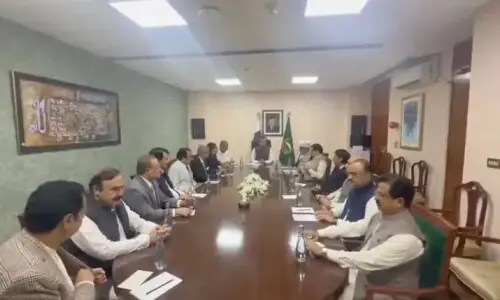
KARACHI: The media is facing one of the toughest challenges it has ever had to face but no one is talking about it; this is a war not just on the media, but democracy as well, said speakers at a session titled ‘Shrinking space for democracy and freedom of media in Pakistan’, on Friday evening at the Human Rights Commission of Pakistan’s office.
The talk was led by Szabist’s social sciences dean, Prof Dr Riaz Ahmed Shaikh, along with HRCP’s Asad Butt and others.
Dr Shaikh started the session by remembering Mashal Khan, the 23-year-old journalism student who was lynched at the Abdul Wali Khan University in Mardan, on his first death anniversary. The dean said that laws exploiting religion and creating intolerance during Gen Ziaul Haq’s dictatorship eventually worked against individuals like Mashal and he ended up losing his life.
He said that the year 2018 was very important as it marked 50 years of struggle all over the world. “The year 1968 was when several movements started in different countries across the globe, including France and Pakistan,” he said, adding that then we were struggling against 10 years of Gen Ayub’s martial law.
“If we look around today, it looks like our struggle never stopped and we are stuck ... we still worry if the elections are going to be fair and free, are they going to put the same kind of ‘puppets’ in the government like they did with the Senate and what role the media plays in all of this. These are issues we need to sit down and discuss,” he said.
Then he got into the history of Pakistan’s democratic journey, claiming that democracy was introduced by the British soon after the 1857 War of Independence. The dean said that at the time, Sir Syed Ahmed Khan claimed that democracy would not survive in the subcontinent as the people were influenced by religion, caste system and brotherhood. He also briefly discussed pre-Partition laws and elections. He followed this with examples of India, Sri Lanka, Bangladesh and Nepal — countries which have successful democratic system of government.
Discussing democracy in Pakistan, Dr Shaikh examined works by academics such as Khalid bin Saeed, Shahid Javed Burki’s Insider and Outsider which looks at the urban-rural divide, Tahir Amin, Hamza Alavi’s overdeveloped postcolonial state and Feroze Ahmed who talks about service bourgeois. Dr Shaikh further went on to discuss the country’s current situation — looking at the politicians and military.
Talking about the media, he said that things had changed. “In March 2007, the lawyers’ movement created a new dimension of public opinion in the country. People were talking openly, which is why Gen Musharraf had to step back. But then, a few months later in November, it was the media who suffered the most. They were forced to have talk shows in D Chowk,” he explained.
“The media has played a very important role since then — look at the Kerry-Luger bill, Salala check post attack, Memogate; the media developed perception and an opinion,” he added.
Published in Dawn, April 15th, 2018