0
0

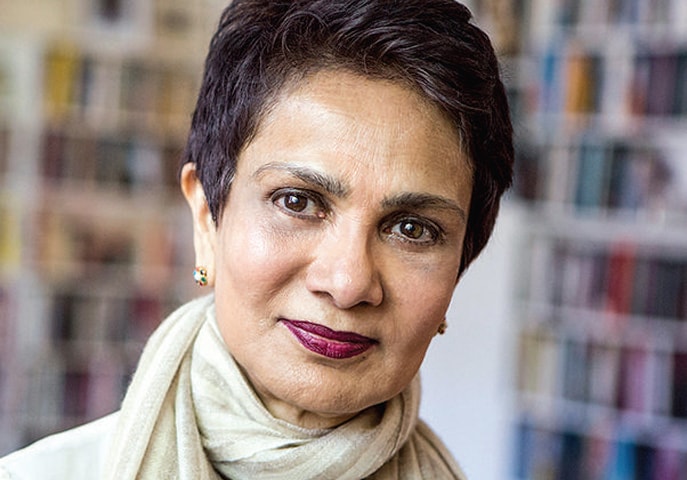
Dr Azra Raza is the co-author of Ghalib: Epistemologies of Elegance, written with Sara Suleri, as well as the Chan Soon-Shiong professor of medicine and director of the Myelodysplastic Syndrome (MDS) Centre at Columbia University. Her latest research is focused on understanding the aetiology and biology of MDS using the latest genomic technology.
Dawn caught up with Dr Raza while she was in Islamabad, en route to Lahore to deliver the keynote address at this year’s Lahore Literature Festival.
Q: How did you get started learning poetry?
A: I come from a deeply oral tradition where committing poetry to memory and quoting a sher in every reasonable context was as natural as breathing.
My parents asked us to recite poems not just for visiting guests but over routine family dinners. Poetry was a part of our existence. They struggled hard to correct and refine our pronunciations, which sadly never came up to their pristine standards.
Once I began to read on my own as an adult, I found Ghalib’s ghazals both ravishing in their sheer beauty and challenging in their uncompromising difficulty, which demanded continual reinterpretation.
At the age of 28, I set up an Urdu mehfil in Buffalo, New York; a few friends would get together at my home on a weekly basis to read one or two ghazals of Ghalib with extant sharahs that were available to us. It quickly became obvious that as readers, our errors provided opening into re-readings of the text ad infinitum.
Q: Tell me a little about the ethos of your book - why Ghalib? Why in English?
A: I have not faced an intellectual issue or question in my life which Ghalib has not addressed directly or indirectly in his magnificent diwan.
The reason for the English version was twofold. First, there are at least seventy Urdu sharahs of Ghalib’s diwan, but because the nature of issues he addresses relate to the Israr-i-Azal, man’s universal search for the essential mystery, I was keen to bring a novel interpretation from the perspective of someone with a Western sensibility.
Sara Suleri Goodyear, a professor of English at Yale, a Pakistani who is also half-Welsh, a living legend in the world of Western literature and a fellow Ghalib aficionado, was my perfect partner in this venture. The second reason was to introduce the staggering genius of the great poet to our younger generations who read and speak Urdu but remain unaware of the layered complexities of the language.
Q: What is a typical day in your life? When do you find time for poetry?
A: I start early, between 4-5am and put in several hours of reading and writing before going out for my daily morning jog in Central Park or by the Hudson or the East River in Manhattan. It is during this 4-5 mile run that I commit poetry to memory.
Examples include large portions of Mussadas-i-Hali, Masnavi-i-Zehr-i-Ishq and Behr-i-Taveel by Nazir Akbarabadi and by Muztar Khairabadi. I recently committed to memory the entire thirty-third canto from Dante’s Paradiso. It is a beautiful daily experience. I also get obsessed with one sher at a time.
At the moment, I have been thinking about: Manzar ek bulandi par aur hum bana sakte/Arsh sey udhar hota kash keh makaan apna [Could we build on some pre-eminence and see what lay below/If only we had a different home, apart from the sky].
This curious sher concentrates an artist’s eye on issues of perspective and of psychological and metaphysical habitation – what is gained in infinitude is lost in the finite. This is one of the few shers in which Ghalib is so overtly architectonic.
Q: Who are your favourite living authors - of prose and of poetry?
A: My all-time favourite living prose writer is Sara Suleri Goodyear. The only other writer in the same class was my beloved Aini Apa [Qurratulain Hyder] who is no more. My favourite poets are many, but I am always deeply moved by Fahmida Riyaz.
Published in Dawn, March 22nd, 2018