4
4
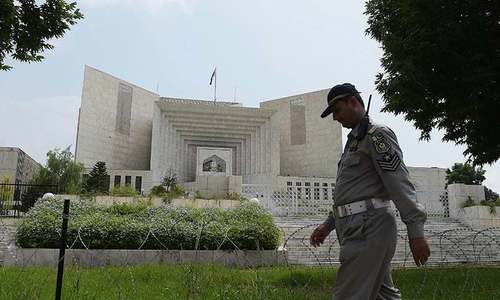
ISLAMABAD: The Supreme Court issued on Wednesday a show-cause notice to the management of English daily The News for committing contempt of court and summoned its reporter, chief editor and printer to appear before it after two weeks.
“We prima facie feel that the said report may independently constitute contempt of this court under Article 204 of the Constitution, read with Section 3 of the Contempt of Court Ordinance 2003,” observed Justice Asif Saeed Khosa while dictating the order at the conclusion of the proceedings.
The contempt notice was issued by a three-judge SC bench on a story by reporter Ahmed Noorani published on July 6, 2017 in The News headlined “SC directed ISI to look after JIT affairs”. The report had suggested that the supervision of administrative affairs of a joint investigation team (JIT) by the Inter-Services Intelligence had been made on a directive issued by the implementation bench of the Supreme Court on the Panama Papers case.
Reserves ruling on contempt case against Nehal Hashmi
Meanwhile, the same bench headed by Justice Khosa reserved its ruling on a contempt case against PML-N loyalist Senator Nehal Hashmi for his May 28, 2017 outburst. In his speech, Mr Hashmi appeared to have threatened members of the SC-appointed JIT and the judiciary for investigating former prime minister Nawaz Sharif and members of his family in the wake of the Panama Papers leaks.
The court closed the contempt proceedings when Mr Hashmi tendered an unconditional apology and threw himself at the mercy of the court through his counsel Kamran Murtaza, though he had initially contested the charges.
In The News case, the Supreme Court allowed its management to submit its reply to the show-cause notice.
Earlier on July 10, 2017, the Supreme Court had issued a contempt notice against reporter Noorani, Chief Editor and Publisher of The News and Urdu daily Jang Mir Shakeel-ur-Rehman and Printer Mir Javed-ur-Rehman for contacting a judge of the apex court as well as misrepresentation of an earlier court order in its publication of June 21.
On Wednesday, the Supreme Court converted the July 10 notice into a show cause after the reporter hesitated to utter the word “apology” in his reply to the notice, though he expressed his regrets and stated that he threw himself at the mercy of the court.
The court even provided the respondents an opportunity to think over and jot down their replies, but Mr Noorani said he did not want to submit the apology because it would then be considered an acceptance that he had acted with mala fide intentions. He said he would like to contest the case.
At this, the court observed that he had every right to contest and tried to make him realise that laws of contempt did not recognise the word regret, and unless he tendered the apology the contempt matter would not end.
Justice Khosa observed that the court, while deciding the matter, would also consider the services of the reporter as a journalist.
The reporter, however, declined.
Subsequently, Justice Khosa observed that this was not an apology and, therefore, not acceptable.
When Justice Khosa dictated in the order that when the court required the reporter to support that report with any evidence or matter, he failed to do that and did not refer to any order of the court in any proceedings wherein such directives were issued, Mr Noorani again contested that the court had never asked him about the material and he would submit in writing how some officers confided this information to him.
At this, Justice Khosa said the order had not been signed and the court could change its order as it only wanted to help the reporter. He observed that when the reporter submitted his reply in writing, the court would also summon those officers to inquire about the allegations.
The court observed that it would consider later separating the contempt case of Mr Noorani from other contempt notices when Attorney General Ashtar Ausaf requested it to separate the same.
Justice Khosa, however, regretted that the court was left with no option but to proceed with the contempt matter, adding that the reporter had levelled allegation which was not a small thing.
But the reporter insisted that it was a story, and not an allegation.
The court said the reporter had conceded in his reply that he had attempted to make contacts with the Supreme Court judge.
The reporter, however, stated in his reply that he thought making contacts with judges was a norm and, in his defence, provided the clippings of stories of Ansar Abbasi who had established contacts with then chief justice Abdul Hameed Dogar.
Published in Dawn, January 25th, 2018