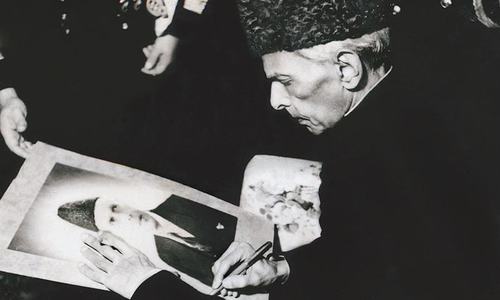
KARACHI: Paying tribute to one of the most extraordinary man in history, TDF Ghar’s exhibition titled The Jinnahs opened on Tuesday with the aim to bring the Quaid’s personal life out of the shadows, in particular his relationship with the three powerful women who he was closest to — Fatima, Ruttie and Dina.
With volumes dedicated to the Quaid’s professional achievements and his struggle for a separate nation, the public does not know much about his family and in particular these women, and The Dawood Foundation painstakingly researched, compiled and presented as much information about them.
Explore: A Partition too deep — How events in 1947 shaped Pakistan today
The exhibit starts off with images of Ruttie’s letters to Jinnah, in particular her last letter to him, her words reveal the heartbreak and love the two shared and how their relationship did not pan out the way both had envisioned it to be. There is also a trip down memory lane to the time the two first met in Darjeeling. She was 16. Age was not the only deterrent as they belonged to different religions too. Yet nothing could stop their love and they married in secret in April 1918.
Also read: A life well spent on all counts
“Their marriage began to crack after 1921. Ruttie moved to London with their daughter, Dina, in 1922. In June 1928, they had separated. Ruttie fell ill and died on Feb 20, 1929 on her 29th birthday.”
Dina’s presence at the exhibition is also potent with letters she wrote to her father congratulating him for achieving the dream of Pakistan. In one letter she writes: “I must congratulate you — we have got Pakistan … how hard you have worked for it. … I do hope you are keeping well — I get lots of news of you from the newspapers.”
Using history books, biographies and newspaper archives, the exhibition carefully credits where the information is taken from.
As for Fatima Jinnah, we are offered insight into the shared struggle and how she lived with her brother during the more critical, the more trying years of his life. Fondly called ‘Fati’ and supported him through tough times. In the Quaid’s own words: “During all these years of worry and hard work my sister was like a bright light of hope, whenever I came back home and met her. … She never grudged, she never grumbled. For solid 10 years she stood by me and sustained me.”
According to the exhibit, Miss Jinnah was responsible also for bringing the Muslim woman into the political affairs of the Muslim nation. “She evolved into a political worker, promoted women’s health, education, political and social matters.”
The 1998 biopic, Jinnah, starring Christopher Lee as the Quaid, was also shown in a separate room at TDF Ghar.
Published in Dawn, January 17th, 2018