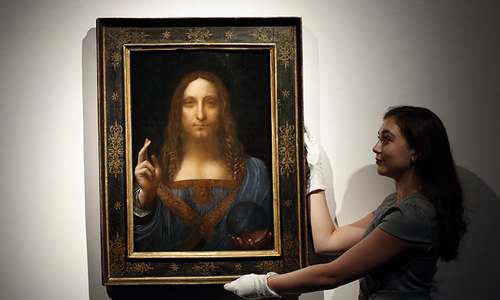
“Salvator Mundi,” a painting of Christ by Renaissance master Leonardo Da Vinci that recently sold for a record $450 million, was acquired by the Abu Dhabi Department of Culture and Tourism, said Louvre Abu Dhabi on its Twitter page.
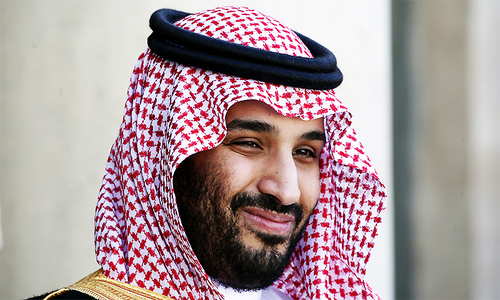
This information was shared by Louvre Abu Dhabi a day after international publications ran the news that Saudi Crown Prince Mohammed bin Salman was the actual buyer of the painting by Leonardo da Vinci.
The Wall Street Journal and The New York Times on Thursday had reported that the young and dynamic crown prince, known by his initials MBS, used an intermediary to buy the much-sought-after painting of Christ.
The painting — one of fewer than 20 works generally accepted as being by the Renaissance master, according to the auction house Christie’s — was bought by little-known Prince Bader bin Abdullah bin Mohammed bin Farhan al-Saud, reports said. The Journal reported that Bader was the nominal buyer, but had said MBS was identified in US intelligence reports as the true owner.
NYT had also identified Prince Mohammed as "the true buyer" behind the purchase of “Salvator Mundi”, citing "American officials and an Arab familiar with the arrangement".
On the same day, however, Prince Badr in a statement published by pan-Arab newspaper Asharq al-Awsat said that he had “read with great surprise the report published about me in The New York Times newspaper and the strange and inaccurate information it contained.”
According to a report by Al Arabiya on Saturday, a UAE government official confirmed the painting belonged to the Abu Dhabi government and would be put on display at the Louvre Abu Dhabi.
“We own it,” the official was quoted as saying. The daily added that a Saudi official told Reuters: “Contrary to media reports, Crown Prince Mohammed bin Salman did not purchase this art piece.”
The official, according to Al Arabiya, added that the Abu Dhabi Department of Culture and Tourism had subsequently asked Prince Badr to act “as an intermediary purchaser”.
The Financial Times on Saturday offered another theory behind the sought-after painting's purchase, saying that the painting was a "gift" to the Abu Dhabi government.
According to the publication, a person briefed on the deal said that Prince Bader bought the painting on behalf of the Saudi government with the understanding that Saudi Arabia would gift it to the UAE as a sign of the strong friendship between the two countries.
“It is supposed to be a state to state gift, like when France gave the Statue of Liberty to the US,” the person was quoted as saying.
The Saudi and UAE governments, however, have neither confirmed nor denied the painting being bought or received as a gift.
Abu Dhabi’s powerful crown prince, Mohammad bin Zayed Al Nayhan, is believed to have a close relationship with Saudi Arabia’s young crown prince. Over the recent years, the two countries have cultivated even-closer ties.
Last week, UAE announced that it had formed a new “joint cooperation committee” with the kingdom to partner on economic and military issues, separate from the Gulf Cooperation Council (GCC).
The new “committee is assigned to cooperate and coordinate between the UAE and Saudi Arabia in all military, political, economic, trade and cultural fields, as well as others, in the interest of the two countries.”