Rather than asserting that the military and the judiciary could be criticised if criticism was merited, a distinguished minister has taken the position that parliament is just as sacrosanct and hence above being challenged.
In anticipation of what is likely to follow, this being Pakistan, one cannot afford to lose any time taking to task another minister who has asked for the treatment. I am referring to a news item in which the minister for industries, commerce and investment has informed the Punjab Assembly that there would be “no tomato import despite mafia’s manoeuvring”.
Examine: Trading priorities
The minister is said to have elaborated that “now tomatoes from Khyber Pakhtunkhwa were being sold at Rs70 per kilo in the city and would continue to be sold till prices get further stabilised with supplies from Sindh arriving in the local market”. The justification for the policy is contained in a direct quote from the minister: “Why pass the advantage on to foreign farmers instead of our own?” According to the minister, “an influential mafia” was trying hard for resumption of import from India which would not be allowed to happen.
This minister needs to have a whole load of rotten tomatoes thrown at his head and the party chief responsible for his appointment to the ministry needs to explain the poor selection. Imagine a modern minister for commerce who can publicly state “Why pass on the advantage to foreign [producers] instead of our own?” Just follow through with the implications of the logic — it would put an end to all international trade because the only things traded are those that are made better or at lower cost by foreign producers.
When tomatoes were selling for Rs300 a kilo in Lahore they were available at Indian Rs40 in Amritsar.
There are a whole host of other problems with the argument. First, note the irony that the statement is coming from a minister in a country where even common pins are being imported from China and garbage collection is being contracted out to the Turks. There has not been a peep about the advantage being passed on to foreigners in these and a slew of other sectors.
Second, this newfound love of ‘our own’ is confined to producers, setting aside entirely the welfare of consumers who vastly outnumber the former. Why? Are consumers not equally our own? And is the government not elected to enhance the welfare of the majority?
Third, what if someone extends the minister’s argument to the provincial level? Why pass on the advantage to producers in KP and Sindh instead of our own farmers in Punjab? Such a person would immediately be labelled an anti-national element even though the logic of the argument remains unchanged.
Fourth, who is this ‘influential mafia’ trying hard for resumption of import from India? What does it have to gain from the import? And, if this is actually a resumption of something that was taking place earlier, why wasn’t this mafia hauled in for anti-state activities at that time? Could it not be a producer mafia trying to block imports? Would a producer mafia not be infinitely more influential than one of consumers?
The point of all these seemingly absurd questions is to highlight the mindlessness of the minister’s statement and the sheer vacuousness of the logic offered for his decision. The fact of the matter is that a blind nationalism is at the bottom of this ridiculous anti-trade stance that is hurting the budget of the vast majority of citizens who have to purchase essential commodities in the market.
At the time when tomatoes were selling for Rs300 a kilo in Lahore they were available at Indian Rs40 a kilo in Amritsar a mere 30 miles away. But a visceral Indo-phobia, shared by many of our influentials, stood in the way of consumers benefiting from the lower priced supply. It was then that another distinguished minister, the federal minister for national food security and research said that “the government will never allow import of any vegetables, including tomato and onion, from India despite record high prices of these kitchen items in local markets due to limited local supply”. He elaborated that “this step has been taken to encourage the local farmers to grow more besides saving huge foreign exchange”.
Our ministers are not alone in articulating such puerile logic emanating from their Indo-phobia. I recall a meeting in which an ex-chief of the ISI similarly railed against trade with India because it would destroy “our own” industry. The specific example he gave was of footwear that was being produced at lower cost across the border and whose import would put Pakistani producers “out of business”. During a break, a participant jokingly inquired about the make of the shoes the chief was wearing — it turned out they were Italian.
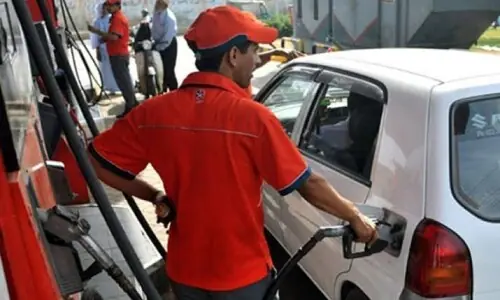
The point to note is that this India-centric anti-trade hysteria is shared by many who have no compunctions consuming products imported from all other countries and whose income brackets are such that commodities like tomatoes and onions are a minuscule proportion of their budgets. These are people who tell their car drivers to fill up the tank without ever asking the going price of petrol. They are indulging in the psychic pleasure of ‘hurting’ India at no cost to themselves while pushing millions of people who can afford to buy only a litre of gas at a time below the poverty line.
The ultimate irony is that such callous and shallow prejudice does virtually nothing to hurt India. On the contrary, the gap between the two countries continues to widen while our leaders make fools of themselves trying to prove to a wide-eyed world that India is the ‘mother of all terrorisms’. It is a sad commentary on the state of affairs and a sign of the extent to which people have given up that nobody even bothers to point out these follies before the narrow window for questioning inevitably draws tightly shut.
The writer was the dean of the School of Humanities and Social Sciences at Lums.
Published in Dawn, October 27th, 2017