In the corridors of power in Balochistan, Hazara persecution means little to others. When a Hazara gets gunned down or when their homes are bombed, it simply registers as life as usual for most in power.
This is the conundrum being faced by the Hazara community in Quetta. Hundreds of Hazaras living in Quetta have left their abodes, leaving behind the lives that they and their forefathers had painstakingly built. At first, it seemed like a minority was leaving. But with over 70,000 Hazaras now having migrated away from Quetta, the trickle has become a flood.
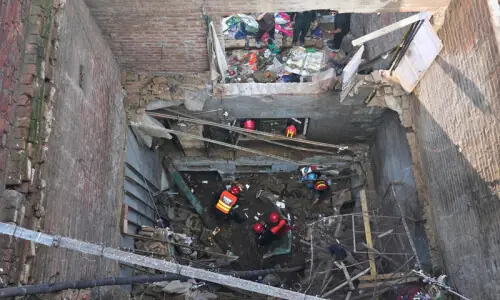
The Hazara community in Quetta is ghettoised in two localities in the city’s eastern and western sides: Marriabad and Hazara Town. Most do not step outside of their areas or loiter around the city because their distinct facial features make them easily recognisable targets. If they do, as three Hazara vegetable vendors roaming Kasi Road in search of customers did, then they tend to get killed.
Police sources, meanwhile, maintain that they always provide “foolproof security” to Hazaras when they leave their homes to visit the suburbs, such as Hazarganji, to buy fruits and vegetables. “The three Hazara vegetable vendors, who were shot dead at Kasi Road, left for Hazarganji from Marriabad without informing us [the police and Frontier Corps],” argues one senior official. “That is why the incident occurred.”
The recent killings of Hazara vegetable vendors in Quetta, and before them a family of four in Mastung, pose the question of whether death by terror is their only fate
Another official echoes the thought, citing the burden of history as proof for why this practice of informing law enforcement about their movement became standard.
“In the recent past, too, Hazara vegetables vendors were going to Hazarganji from Hazara Town on their own, without informing law enforcers,” he says. “That is why the attacks occurred, too, which took away their lives. The police and other paramilitary troops are out in Quetta and around the Hazara dominated areas for their security, so they should at least inform us before leaving.”

It is almost unfathomable for such surveillance to become routine in any other part of the country. Not only is it an immense burden on law enforcement but a matter of eternal anxiety for the Hazara community. This is why many members of the community see greener pastures abroad and the “Trend of Australia” took root among the Hazara.
Gradually and slowly, they started leaving. This exodus from Quetta was triggered due to an unrelenting wave of targeted violence aimed at them since 1999. While earlier migrations were because families saw a brighter future elsewhere, they now leave due to fear.
“Most Hazaras did not want to leave our city without rhyme or reason,” argues Hazara columnist Hasan Riza Changezi. “But since 1999, when the targeted killings started, an exodus also began from the city. As Australia was easy to go to back then, many Hazaras would leave for Australia.”
The Hazaras are undoubtedly among the most educated communities of Balochistan because their elders invested heavily in education — both in terms of money spent and energy. As a result, a new, talented Hazara generation was raised which had great representation in Balochistan’s health, education, and other government sectors. Many were also entrusted with key positions and responsibilities. Unfortunately, many had to quit their professions and businesses to settle abroad.
Although the year 1999 is marked as the year that the targeted violence against the Hazara began, things didn’t reach a tipping point till later. Even in the post-2000 period, Hazara Shia mourners would stage their rallies on Ashura, passing through different roads of Quetta without overwhelming security. Anyone could mingle with them with ease as there was no concept of a conflict existing between the Sunni and Shia at the time.
Nevertheless, due to sectarian violence that gripped Balochistan thereafter, things changed completely.
Hazara community members and elders claim that approximately 70,000 Hazaras have left the country to escape persecution. “At least 50,000 Hazaras have gone to settle in Australia, around 8,000 are stuck in Indonesia, while around 10,000 of them have gone to Europe,” claims one elder. Then there are those who have migrated to other cities of the country since Quetta was no longer safe for them.
During the last Pakistan Peoples Party government, sectarian elements warned Hazaras of dire consequences if they did not leave Quetta voluntarily by the end of 2013, otherwise they would be killed and barred from leaving the city as well. A Human Rights Watch report from that time states: “There is no travel route, no shopping trip, no school, or no work commute that is safe for the Hazaras.”
Since (in)security defines the Hazara exodus, the number of people leaving Quetta tends to increase whenever the Hazara community becomes victim of terror. Many escape first to Indonesia or Malaysia, and then onwards to Australia.
“After 2006 and 2012, many families chose to leave the city forever,” says Changezi. “In the beginning, it was quite easy to obtain an Indonesian visa. That is why Hazaras would first head to Indonesia. From there, they’d travel to different islands, and from there they would reach Australia.
But this route is laced with peril.
In 2013, a gang of human traffickers was arrested by the Federal Investigation Agency’s Anti-Human Trafficking Circle. The gang revealed that 94 Hazaras drowned after the boat illegally transporting them from Indonesia to Australia capsized and sank. In another case, also from 2013, 60 Hazaras died when their boat capsized in Indonesian waters en route to Australia.
“These days, we often migrate illegally,” explains Ahmad Raza Hazara. “As compared to Australia, New Zealand waters are very rough and dangerous, so Hazaras rarely leave for New Zealand. But now the Australians have also banned people’s arrivals on boat.”
“Around 800 Hazaras have so far died in incidents where their boats have capsized,” claims Changezi. “Sometimes, they are in their boats for months.”
And when they disembark too, life is hardly a bed of roses. Those who were once public servants or businessmen in Quetta are reduced to menial jobs abroad.
“No one happily leaves their place of birth until and unless they are compelled to,” concludes Changezi.
The writer is a member of staff.
He tweets @Akbar_Notezai
Published in Dawn, EOS, October 22nd, 2017