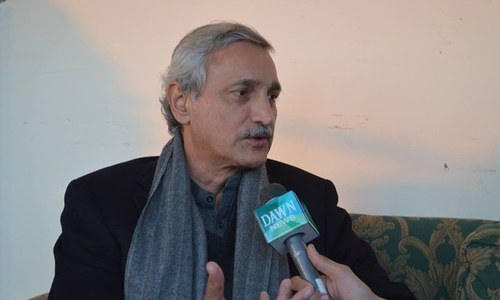
The Supreme Court (SC) while hearing the disqualification case against Pakistan Tehreek-i-Insaf (PTI) leader Jahangir Tareen on Thursday deliberated the nuances of the definition of integrity as under Article 62(1)(F) of the Constitution before adjourning the case until Oct 23.
Under the article, a person is not qualified to hold public office if he is not ‘sadiq' and 'ameen’ ─ truthful and trustworthy.
A three-member apex bench ─ headed by Chief Justice Saqib Nisar and comprising Justice Umar Atta Bandial and Justice Faisal Arab ─ was hearing a petition filed by PML-N leader Hanif Abbasi which seeks the disqualification of Tareen and PTI Chairman Imran Khan over the alleged non-disclosure of assets, existence of offshore companies, as well as receiving foreign funding for PTI.
Thursday's hearing picked up from yesterday's proceedings in which the court questioned whether or not Tareen acted fairly as the director of JDW Sugar Mills when the Securities and Exchange Commission of Pakistan (SECP) had ordered him to pay a fine of Rs70 million in 2005 when his employees engaged in insider trading.
The CJP had asked the parties involved to assist the court in establishing whether the penalties paid by Tareen could be considered part of the public expenditure after his counsel — trying to establish that the fine imposed could not be considered a ‘conviction’ — argued that the payment under sections 15-A and 15-B of the Security Exchange Ordinance 1969 had nothing to do with the consolidated funds and that penalties imposed under it never went to the public exchequer.
Justice Bandial, however, asked yesterday whether it was a rightful exercise to allow personal benefit, especially when Tareen — as a director of the JDW Sugar Mill — was privy to specialised information about the acquisition of USML.
“We are not looking into conviction, only questioning whether you acted fairly or not,” Justice Bandial had observed.
The counsel, however, had argued that sections 15-A and B did not even remotely relate to the imposition or regulation of taxes.
When the court had observed that the counsel was trying to wriggle his way out of the law, the lawyer had responded by citing Article 4 of the Constitution, which ensures the right of all individuals to be dealt in accordance with the law.
Tareen's counsel, Sikandar Bashir Mohmand, today said that his client wished to close the matter with the SECP as he had already paid a fine to the regulatory body.
Justice Arab raised the question of whether action could be taken under criminal law against insider trading. "If the SECP law is correct, then do Tareen's actions exhibit integrity?" he asked.
Mohmand said his client had already provided his justification to the SECP and it was his honesty that had helped him avoid getting into any controversy over insider trading. He added that Article 62(1)(F) specified what honesty means.
Justice Bandial observed that in some countries, insider trading is permitted, while in others it is not.
The CJP said that each country had its own laws. "We have to look at the case within the limits of our own law [...] we are hearing each petition with no boundaries. Each day, new questions arise," he said.
"The case is related to integrity and integrity has a number of meanings. If we are attempting to disqualify a member of the parliament over lack of integrity, we first have to ascertain what integrity means," he added.
The CJP questioned whether integrity had anything to do with corruption, or with those who hold public office.
"We will have to be attentive to such questions," he said.
There are many questions the parties have to answer, the chief justice said, adding that disqualification over ignorance of Article 62(1)(F) was being discussed.
"If a child lies about the time to get off early, is this not a lack of integrity?" the CJP questioned. "Who will prove that he intentionally told the time wrong?"
Subsequently, the hearing was adjourned until Oct 23 and the additional attorney general was notified to provide his opinion regarding sections 15-A and B of the SECP law.