ISLAMABAD: Defiance of court orders is nothing new for high-profile figures across the political spectrum, and most of them have been declared proclaimed offenders for avoiding proceedings, in one case or another.
The issuance of arrest warrants is nothing new for figures such as Pakistan Tehreek-i-Insaf (PTI) Chairman Imran Khan, Pakistan Awami Tehreek chief (PAT) Dr Tahirul Qadri and All Pakistan Muslim League (APML) President retired General Pervez Musharraf, who have all been declared proclaimed offenders by an anti terrorism court (ATC) in Islamabad.
The former prime minister’s sons Hussain and Hassan Nawaz are the latest entrants to this club, after a proclamation notice asking them to surrender was pasted at the court premises on Thursday.
On the same day, even the Election Commission of Pakistan (ECP) issued non-bailable arrest warrants for Imran Khan in the foreign funding case. But the PTI chief seems unfazed and his legal team has already announced its intentions to challenge the warrants.
Nawaz Sharif’s sons, Imran Khan, Tahirul Qadri, Pervez Musharraf have all been declared proclaimed offenders by the courts
Earlier, on Oct 9, an accountability court declared Hussain and Hassan Nawaz ‘absconders’ for not turning up for the proceedings of the three references filed against them on the directions of the Supreme Court.
Several other politicians, including Awami Muslim League (AML) President Sheikh Rashid Ahmed and 33 senior PTI politicians are also wanted in a case related to the attacks on Parliament House and Pakistan Television (PTV) during the 2014 sit-in.
The former military ruler, meanwhile, evaded proceedings in a treason case for suspending the Constitution on Nov 3, 2007.
In addition to Mr Khan and Mr Qadri, the ATC has also issued non-bailable arrest warrants for Sheikh Rashid Ahmed, Khyber Pakhtunkhwa Chief Minister Pervez Khattak, PTI leaders Shah Mehmood Qureshi, Jahangir Tareen, Asad Umar, Shaukat Yousafzai, Shafqat Mehmood and Arif Alvi and PAT leaders Rahiq Abbasi, Sardar Assef Ahmed Ali and others in Nov 2014.
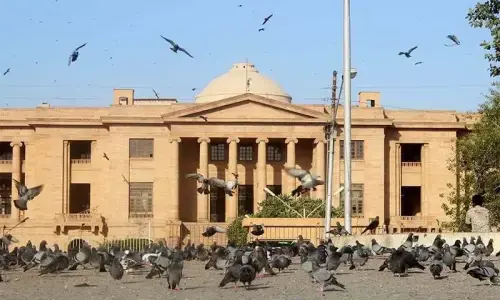
The courtroom where the ATC is holding proceedings against PTI, PAT and APML is in the same corridor as the accountability court hearing the cases of the Sharif family. Both these courts are situated within the Federal Judicial Complex (FJC) in Islamabad’s Sector G-11/4.
Gen Musharraf was implicated for having detained 60 judges of the superior judiciary after imposing an emergency on November 3, 2007. He is also facing a high treason case in a special court for imposing an emergency and both courts have declared him an absconder.
The former military ruler initially appeared in both these cases and was then exempted from personal appearance. However, these courts started the process of confiscating his properties – a move that is initiated once an accused is declared a proclaimed offender because of his constant absence from court proceedings – after he went abroad.
He left the country once his name was removed from the exit control list (ECL) on the order of the Supreme Court of Pakistan.
The PTI and PAT chairmen, meanwhile, were declared absconders in the case related to the attack on then-Senior Superintendent of Police Asmatullah Junejo during the sit-in of 2014.
On Sept 1, 2014, around 50 protesters, allegedly from the PTI and PAT, attacked and injured SSP Junejo. Initially, the police arrested six individuals who were allegedly involved in the attack.
In addition to the unidentified attackers, the police had also nominated Mr Khan and Dr Qadri as accused in the case. The ATC declared them proclaimed offenders in Nov 2014 after neither appeared before the court despite the issuance of summons and arrest warrants.
In July this year, the ATC declared them absconders and started the process of confiscating their movable and immovable properties.
In the case related to attacks on Parliament House and the PTV building, the court is yet to issue proclamation against the accused persons for their continuous absence.
The PTI leadership tries to justify their boycott of the trial by arguing that these are politically-motivated cases. However, legal experts do not necessarily agree.
Advocate Faisal Hussain, a counsel for PTI activists booked in these cases, told Dawn the government had registered false cases against political workers and leaders, calling it “political victimisation”.
Former Supreme Court Bar Association president Syed Ali Zafar said that “it shows the weakness of the court that accused are given the power to decide whether or not they join the trial proceeding,” adding that the court has every power to ensure the attendance of the accused persons.
If the case against an accused is frivolous, even then the accused person has to prove it before the trial court he said.
Published in Dawn, October 13th, 2017