Abe — nationalist blue blood at home, shrewd diplomat abroad


TOKYO: Japan’s Shinzo Abe, who called snap elections on Monday, is seen as a pragmatic and canny diplomat who has cosied up to Donald Trump and Vladimir Putin while pushing a nationalist agenda at home.
Groomed for power from birth, the 63-year-old is often viewed as arrogant but has also shown a self-deprecating sense of humour, dressing up as video game icon Super Mario as the Rio Olympics closed to give a zany preview of Tokyo 2020.
The third-generation politician captured global attention when he became the first foreign leader to visit Trump Tower in New York — before the now president was even inaugurated — warmly shaking hands with the tycoon in glittering surroundings.
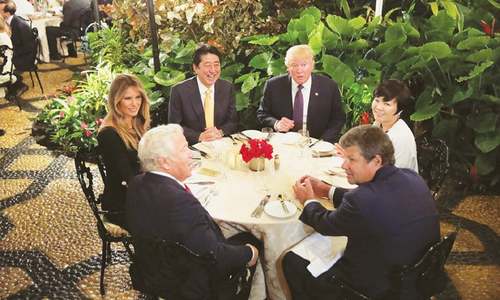
The golf-loving pair then jetted off to Trump’s Mar-a-Lago estate in Florida for a spot of “golf diplomacy”, with the US president praising Abe’s “strong hands” and a “very, very good chemistry”.
This personal rapport proved its worth as North Korea tensions mounted, with the two in regular contact following missile launches by Pyongyang over Japan.
But Abe has also cultivated ties with Putin, inviting the Kremlin strongman to his home town of Nagato for a so-called “hot spring summit” as part of a bid to sign a peace treaty formally ending World War II hostilities.
‘Abenomics’
Abe seemed born to lead Japan, the latest in three generations of powerful politicians.
His grandfather, Nobusuke Kishi, was a World War II cabinet member briefly arrested for war crimes — but never charged — who became prime minister and forged an alliance with the United States.
His father, Shintaro Abe, rose to be foreign minister but never won the top job. Shinzo took Shintaro’s parliamentary seat in 1993 following his death.
Abe cut his teeth by taking a hawkish line on North Korea and became the hand-picked successor to the popular former PM Junichiro Koizumi, whom he served as an eager and earnest deputy.
When he finally reached the top of the greasy pole in 2006 he became the country’s youngest-ever prime minister — aged just 52 — and the first born after World War II.
But he left office abruptly 12 months later, citing debilitating bowel problems caused by exhaustion and stress, becoming the first in a series of short-lived premiers, each of whom lasted around a year.
Recovered, he swept back to power in 2012 on a pledge to reignite Japan’s once-booming economy and carry out “diplomacy that takes a panoramic perspective of the world map”.
On the economic front, he pioneered a multi-pronged policy dubbed “Abenomics”, a combination of generous government spending and central bank monetary easing.
Figures earlier this month showed that Japan — the world’s third-largest economy — was enjoying its longest period of expansion in more than a decade.
However, inflation is stuck stubbornly below the Bank of Japan’s target, as consumer spending remains underwhelming.
In domestic policy, he has pursued a nationalist agenda, openly mulling changes to Japan’s US-imposed pacifist constitution so it could turn its self-defence forces into a full-fledged army.
This has led to tensions with China and South Korea, not helped by his inflammatory visit to the controversial Yasukuni Shrine, seen by Beijing and Seoul as a symbol of Tokyo’s militarist past.
‘Arrogance’
In recent months, Abe saw public support plunge over a series of scandals, including allegations of favouritism to a friend in a business deal — which Abe strongly denies.
When his Liberal Democratic Party (LDP) suffered a drubbing in local Tokyo elections in July, analysts and media blamed it on the increasing “arrogance” of the prime minister and his government.
This left him fighting for his political life — in the words of one observer, scrambling to crawl out of a “hell hole”.
His reputation for arrogance was not helped when he shouted down hecklers at a rally, and voters turned in droves to support charismatic Tokyo Governor Yuriko Koike.
But he swiftly reshuffled his cabinet and polls showed voters approved of his hawkish reaction to North Korean missiles, giving him a bump in the ratings and apparently tempting him into the gamble of a snap election.
On a personal level, Abe is married to Akie, the daughter of a prominent businessman known for her love of South Korean culture.
In the early days of his political career, Japanese media focused on how he would walk hand-in-hand with his wife — an unusual sight in a country where politicians’ partners rarely appear in public.
Published in Dawn, September 26th, 2017