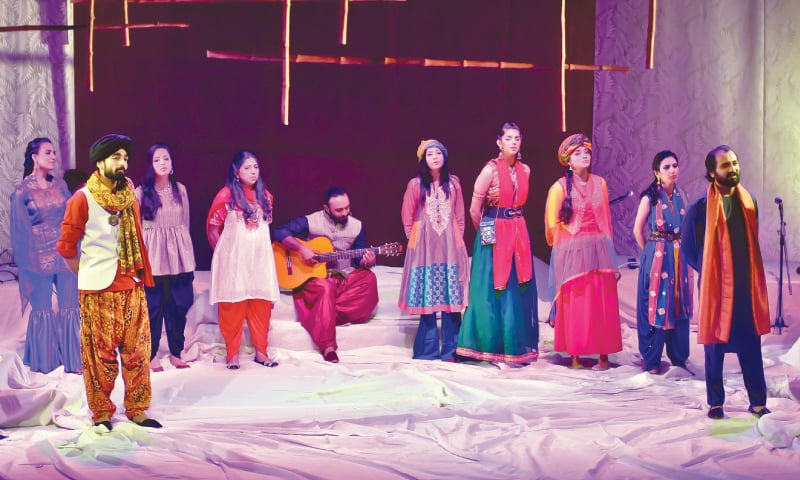
KARACHI: A play in verse is an extremely arduous undertaking for theatre practitioners for one simple reason: actors have to understand the finer points of the metre(s) in which lines are written, and say them with stresses and pauses that create apposite rhythm patterns. Heer Ranjha, an Urdu musical, that its makers say is based on eminent poet Kaifi Azmi’s play, at the Arts Council on Thursday evening tried to remain true to the script, perhaps used in a truncated form. Kaifi Sahib had written the dialogue, all in verse, for a 1970 film having the same title.
Directed by Zain Ahmed, the story, taken from Waris Shah’s poem, focuses on Ranjha (Hassan Raza) from Takht Hazara who goes to Jhang to attend an event, sees a young girl Heer (Sanam Saeed) and falls head over heels in love with her. She reciprocates the feeling.
The villages or small towns have a history of enmity which does not allow their love to blossom despite Heer’s parents’ (Arshad Mahmud plays the father and Samina Ahmed, mother) inclination to lend a favourable ear to their daughter. But it is her uncle Qaidu (Meesam Naqvi), in a manner that reminds one of Iago from Shakespeare’s Othello, who is hell-bent on not allowing Heer and Ranjha’s dream to come true.
It is in Qaidu’s nature: he wants to be bad to the world because fate, in his view, has not treated him well.
Heer Ranjha is, understandably, music-heavy — and this is the most likable part of the production. Music director Nigel Bobby (who also appears in a tiny role in the play) is a revelation. One remembers seeing him in a number of concerts organised by the National Academy of Performing Arts (Napa) but never seen him take centre-stage as a composer. His minimal orchestration (tabla and guitar) never for a moment sounded insufficient for a story that is large in scale and has been performed on several occasions on a variety of media.
The songs and variations on famous folk numbers and songs from the aforementioned Indian film such as ‘Milo na tum to dil’ and ‘Do dil toote’ are aptly used. In fact, the way he himself croons out ‘Main nain jaana’ is a haunting piece in the scheme of the drama.
The play runs for approximately 90 minutes. The choreography is not elaborate but well worked-out. If the actors have a bit more room to do their moves, and not feel cramped, it will further endear them to the audience. For example, the raised platform on which the narrators help the story to leap forward can be done away with.
Hassan Raza has a fine singing voice, and Sanam Saeed says her lines with the kind of emotional longing that’s required for the part (as she usually does). A little bit of vocal training, and she will be right on the money.
Heer Ranjha is a fund-raising endeavour for The Citizens Foundation (TCF). It will be performed in Karachi till Sept 11, after which it will travel to Lahore (Sept 13 and 14), concluding its run in Faisalabad (Sept 16 and 17).
Published in Dawn, September 9th, 2017