Spain moves court over Catalonia's independence vote attempt

The Spanish government asked the country's top court on Wednesday to nullify a vote in the Catalan parliament over a disputed independence referendum bill.
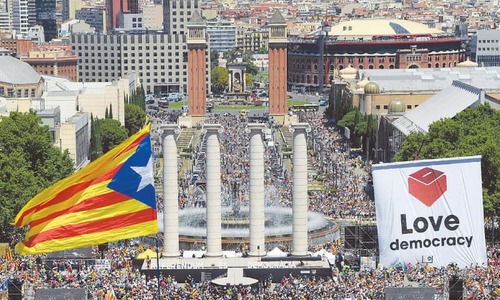
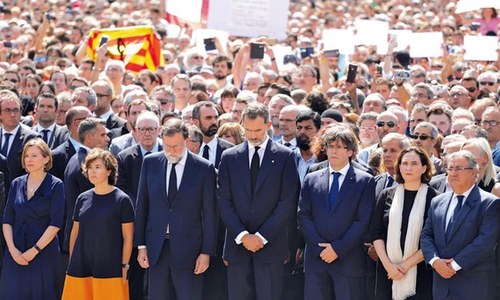
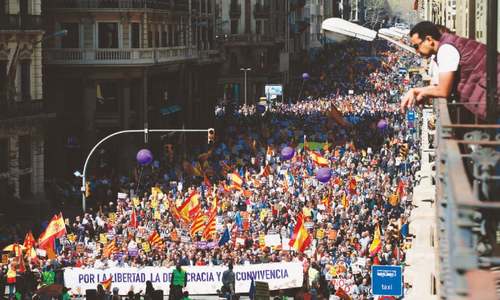
The push from the wealthy northeastern region to hold an independence vote sets Spain — which is still reeling from militant attacks in Barcelona, the capital of Catalonia, and a nearby seaside resort last month that killed 16 people — on course for its deepest political crisis in decades.
Catalonia's regional parliament agreed on Wednesday to debate a bill that calls for the referendum, amid jeers from opponents of independence.
Pro-separatist lawmakers, who control the regional assembly, are expected to pass the referendum bill later on Wednesday with little debate, ignoring a ruling by the Constitutional Court that it would be unconstitutional.
Deputy Prime Minister Soraya Saenz de Santamaria swiftly announced that the government had asked the court to declare “void and without effect the agreements adopted” by the Catalan parliament to vote on the bill.
She blasted the regional assembly's agreement to quickly vote on the bill as an “act of force” that is characteristic of “dictatorial regimes”.
“What we have lived today in Catalonia is the trampling of democracy, the trampling of Catalans, the trampling of political decency,” she added during a hastily called press conference.
At the same time public prosecutors announced they would seek criminal charges for disobedience against the president of the Catalan parliament, Carme Forcadell, and other Catalan officials for allowing the referendum law to be voted on.
'Lost all legitimacy'
In a tweet, Forcadell said earlier she had requested that the 12 judges at the Constitutional Court be disqualified, calling them “another extension of the state which has lost all legitimacy.”
The majority of the court's judges have been nominated by lawmakers from Prime Minister Mariano Rajoy's conservative Popular Party.
Catalonia, a region of 7.5 million people with its own language and culture that accounts for about one-fifth of Spain's economic output, has significant powers over matters such as education, healthcare and welfare.
But Spain's economic worries and a perception that the region pays more in taxes than it receives in investments and transfers from Madrid have helped push the cause of secession from the fringes of Catalan politics to centre stage.
Adding to the rise in separatist sentiment has been a 2010 ruling by the Constitutional Court which struck down parts of a 2006 autonomy charter which granted new powers to Catalonia and recognised it as “a nation”.
Lawmakers who back independence won an absolute majority in the 135-seat Catalan regional parliament for the first time in a September 2015 election.
The government that emerged from that vote vowed to begin the process of breaking away from Spain.
Rajoy responded by promising new investments in Catalonia and regularly sent his deputy to the region but made no significant reforms regarding the division of powers that addressed Catalan concerns.
'Madrid limits us'
Caroline Gray, an expert on Spanish independence movements at Britain's Aston University said Madrid could have defused the rising separatist tide had it offered Catalonia a new financing deal a few years ago.
“If some sort of deal had happened in the past, I personally think we wouldn't be where we are today,” she told AFP.
Opinion polls show Catalans are evenly divided on independence. But a majority, over 70 per cent, want a referendum to take place to settle the matter.
“I hope they will let us vote,” Ramon Sanmartin, a 67-year-old retired engineer, told AFP outside the Catalan parliament. “We want a better Catalonia, with more resources and we feel Madrid limits us.”
Rajoy steadfastly refuses to let Catalonia hold a plebiscite similar to Scotland's 2014 referendum on independence from Britain, which was approved by London and resulted in a “no” vote.
His conservative Popular Party and the court argue that the Spanish constitution does not allow regions to unilaterally decide on sovereignty.
The Catalan government staged a symbolic independence referendum in 2014.
Over 80pc of participants voted to split from Spain although only 2.3m of Catalonia's 5.4m eligible voters took part.