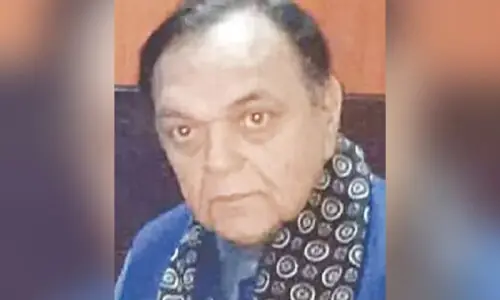
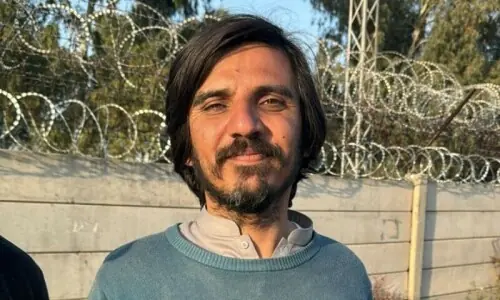
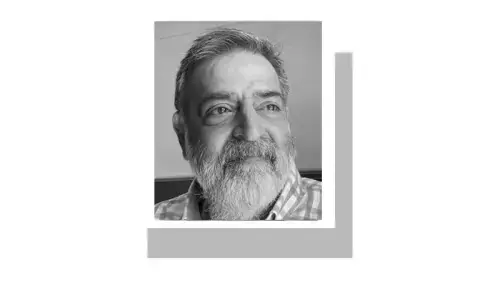
He would wait for his friends outside high school, and walked home with them daily just to satisfy his passion for studies which he was unable to pursue because of financial hardships he had been facing since the death of his father, when he was in grade two. A master calligrapher Ustad Irfan Ahmad Khan was born in 1947 to a family of Hindko speaking farmers in a small village of Mansehra. His father migrated to Lahore in early 50s because of violent family feuds over property issues.
“One of the teachers, Master Tufail, who was our neighbour, noticed me hanging around the school and took me to the headmaster who waived my tuition fee and bought me books,” he recalls.
“Master Inayat would give us a line to write on a ´takhti´ in the primary school of Jehangirabad, Wassan Pura,” he recalls.
A majority of the students developed excellent handwriting (through takhti practice) which was their first exposure to the fundamentals of calligraphy.
He is grateful to legendary calligrapher Moulvi Muhammad Hussain Adily Mubarak Raqm for helping him refine his skills.
When he was in grade seven, he joined daily Urdu Azad as a calligrapher for a living. Life was so tough then.
“I was hardly 12 and the gatekeeper did not allow a very young job seeker to editor´s room. On the third attempt, I managed to meet Shiekh Riaz. After my work was approved by the senior calligrapher, the editor gave me the job as a daily wager and later appointed me as a regular employ.
With this started his career as a ‘katib’ for leading national dailies which lasted for more than three decades.
His retired as the in charge of the calligraphy department at daily Mashriq in 1994 when the newspaper stopped its publication.
“Once newsrooms switched over to computer, it led the skilled calligraphers to venture into art rather than doing laborious jobs, thus the revival of calligraphic arts began,” he said.
He worked for advertising agencies for a short while and developed a simplified Naskh text. Initially it was criticised by traditional pundits but later they accepted it once it became the popular font in print media advertisement, he says.
Later, he joined the Fine Arts Department of the Lahore College for Women as a visiting faculty where he is working as associate professor.
In 1992, he earned a Masters degree in Punjabi and worked to evolve the Punjabi script. He composed a good number of calligraphic works portraying the Punjabi classic poetry.
He was among the team of calligraphers who volunteered to work at the sharine of Data Sahib and later formed the Pakistan Calligraphy-artists´ Guild in 1997.
He is the incumbent president of the Guild which has been running an academy to teach calligraphy to the young aspirants for free for the last 18 years.With two solo shows and numerous group shows to his credit, his works was displayed and appreciated in Pakistan, England, Iran Turkey and Saudi Arabia.
He is the only Pakistan artist awarded by prestigious Iranian Firdousi Award in 2011 for his innovative works rendered in Khat-i-Nastaleeq.
He got outstanding command on Thuluth and Devani but Khat-i-Nastaleeq has been his all time favourite.
Humble and soft spoken, Ustad Irfan is widely respected among his students and contemporary artists.
He is currently working on a collection of works to be displayed in solo shows in England, Germany and Italy.
With a masterly command on traditional calligraphic skills, he firmly believes in innovation and experimentation. He created a wide range of compositions by employing mixed media techniques of western painters and lithography as a background.
Published in Dawn, June 25th, 2017