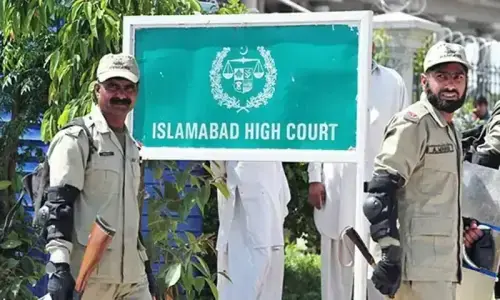
ISLAMABAD: Islamabad High Court (IHC) Justice Aamer Farooq on Tuesday recorded the statement of a doctor in the Tayyaba case.
A doctor testified that 10-year-old domestic worker Tayyaba, who was allegedly tortured by an additional district and sessions judge (ADSJ) and his wife, was brought to a hospital severely and visibly injured.
The witness, a doctor who was on the panel that conducted a medical examination of the alleged victim, said an initial medical examination of the child was conducted and the child had injuries on her hand and face.
Remaining doctors on panel that examined alleged torture victim issued notices for July 4
The other doctors on the panel could not appear before the court because one has retired and the other is attending a training course. Subsequently, the court issued them notices for July 4 directing them to ensure attendance.
The court had previously issued notices to the panel of doctors who examined the alleged victim.
Justice Farooq, while issuing a notice to the witnesses for June 20, has said that the court would continue the trial from the point where another IHC court had recused itself from hearing the case further.
ADSJ Raja Khurram and his wife Maheen Zafar have been charged with assaulting, confining, mistreating, neglecting, abandoning, harming and injuring the child maid.
The couple pleaded not guilty after they were indicted and are currently standing trial.
In January, a member of the Pakistan Institute of Medical Sciences (Pims) medical board had said it was possible that the child was a victim of torture and abuse.
“The minor received multiple burns and other injuries to her back, face, legs and abdomen,” Shaheed Zulfiqar Ali Bhutto Medical University Vice Chancellor Prof Dr Javed Akram had said, adding: “However, it is for the police to decide whether these injuries were the result of torture or not.”
Dr Akram was on the medical board constituted on Jan 6 to re-examine the child at the request of a district magistrate. An earlier medico-legal report from Pims had also confirmed the injuries sustained by the child.
However, the initial examination had ignored burns on the child’s back caused by an iron rod or ladle.
The child was allegedly employed by the suspects as a domestic worker, and they have been accused of keeping her in wrongful confinement, burning her hand, beating her with a ladle, detaining her in a storeroom and threatening her.
The case was widely circulated on social media on Dec 29, 2016. The police subsequently registered a case and the IHC chief justice took notice and directed the registrar to initiate an inquiry.
Recently, Justice Mohsin Akhtar Kayani during a hearing revealed that he had concluded an inquiry and found the judge guilty, and had suggested “major punishment”. The counsel objected to the single bench conducting the trial and inquiry and the court sent the case back to the IHC chief justice.
The chief justice then placed the case before Justice Farooq, who resumed hearing the case where Justice Kayani had left off.
Published in Dawn, June 21st, 2017