0
0

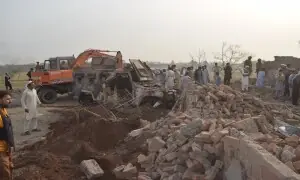
KARACHI: Soon after the Gadani incident in November 2016, in which 32 people died, the number of missing people rose to 10. Although labour organisations in collaboration with the government declared that the bodies of the missing could not be found, one of them, however, still remains in the missing category: Mohammad Shafiq, a Bengali who grew up in Karachi and worked as a daily-wager at the Gadani ship-breaking yard until his death in the Nov 1 incident.
It is said that 250 labourers were working at the site when an explosion occurred in an oil tanker.
Shafiq’s mother, Saira Bano, while addressing a press conference, asked anyone having information about her son to come forward.
Being a Bengali, Saira Bano’s computerised national identity card is blocked on the basis of her status “not ascertained by the institution”; her son did not have an identity card either, which makes it difficult to look for him at hospitals and mortuaries where the CNIC is a requirement.
Bashir Mehmoodani, president of the labour faction of the National Trade Union Federation in Hub, said: “Bengalis and Burmese working at the site are given tasks without consideration for their safety as the state does not recognise them as citizens. So, if in case they are injured or die after an accident, their death would remain unaccounted for as it won’t be officially recognised or accepted.
“What they are doing right now is trying to use Shafiq’s stepfather’s CNIC, who is of Pakistani origin. It’d help us in registering an FIR of him being missing since the incident which would help in getting compensation for the family.”
According to Pakistan Muslim Alliance president Khawaja Salman Khairuddin, an estimated 2,500,000 Bengalis live in 94 localities across Karachi, including Ibrahim Hyderi, Machhar Colony, Korangi and New Karachi. “We as a political party represent the Bengalis since 2001. Another political party, Pakistan Muslim League (Sher-i-Bengal), also represents the Bengalis living in Karachi under the chairmanship of Dr Saleh Zahoor, with a presence in Machhar Colony,” explained Mr Khairuddin.
As PMA’s patron, the 63-year-old recently met Sindh Governor Mohammad Zubair to discuss the issue of non-issuance of CNICs to the Bengalis. “We informed the governor that the community has been facing discrimination on the basis of language for 40 years; that [Bengalis] have been elected as councillors and are included in the voters’ list. And yet, they can’t get their CNICs renewed and have to keep the old ones in order to avoid harassment by police,” said Mr Khairuddin.
Speaking about the harassment faced by both the Bengali and Burmese communities, he said: “Granting
people CNICs after proper investigation would end forced isolation of these communities. They go unrecognised despite contributing so much to industries.”
At present, most of the Bengalis and Burmese work in garment factories, as well as in the textile industry and fisheries, according to Qari Mohammad Sharif, a councillor of Jamaat-i-Islami in Gulshan-i-Iqbal.
“Majority of these workers are not given employment letters; rather [they are given] a card to punch in for attendance while entering and exiting the factories/facilities they work at,” he said.
“It is for this reason when a fire incident occurs, such as the one in Baldia Town’s Ali Enterprises or at the Gadani ship-breaking yard, the Bengalis and Burmese go unrecognised and unaccounted for even in death,” said Mr Mehmoodani.
Published in Dawn, June 14th, 2017