WASHINGTON: India is, so far, the only country after the United States to have tested a nuclear device made of reactor-grade plutonium, which makes its unsafeguarded civilian nuclear facilities a source of concern for others, says a research paper released this week.
The paper — “India’s Nuclear Exceptionalism” — released by the Belfer Centre for Science and International Affairs, Harvard Kennedy School, points out that in its submission to the IAEA in 2008, the Indian government acknowledged the unique nature of its nuclear programme, admitting that it has three distinct categories of nuclear facilities, civilian safeguarded, civilian unsafeguarded and military.
The Indian nuclear stockpile includes over 5.1 ± 0.4 tons of separated reactor-grade plutonium designated as strategic reserve; eight indigenous Pressurized Heavy Water Power Reactors or PHWRs; India’s Fast Breeder Test Reactor (FTBR) and Prototype Fast Breeder Reactors (PFBR).
Other facilities include uranium enrichment facilities; spent fuel reprocessing facilities; the 100 MWth Dhruva-I production reactor; the Advanced Heavy Water Reactor; three heavy water production plants; and various military-related plants.
The study points out that in 1962, the United States conducted a successful test of a nuclear explosive device that used fuel-grade plutonium in place of weapon-grade plutonium, and produced a yield of less than 20 kilotons
The only other country besides the United States that has recently used reactor-grade plutonium in manufacturing and testing a nuclear explosive device is India.
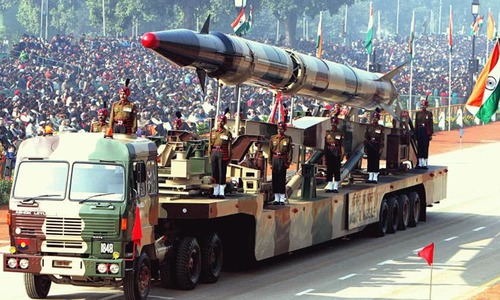
“India is still actively engaged in completing a full nuclear triad and modernising its conventional and strategic nuclear forces to simultaneously face the prospect of a two-front war with China and Pakistan,” says the paper’s author, Mansoor Ahmed.
“India is (also) expanding and improving its existing reprocessing capability for its unsafeguarded civilian and military research, power and breeder reactors,” he adds.
According to influential Indian strategists and defence ministry officials, this requires a force of at least 350-400 weapons, including thermonuclear warheads.
The paper claims that India is the only non-NPT nuclear weapon state that is engaged in a large-scale expansion of its reprocessing capacity, primarily rationalized by plans to construct a growing fleet of breeder reactors that are to be fuelled by MOX initially and eventually metallic plutonium.
The primary source of India’s nuclear capability is the weapon-grade plutonium and HEU being produced in its steadily expanding fissile material infrastructure.
The second source is the stockpile of unsafeguarded separated reactor-grade plutonium and unsafeguarded HEU in excess of India’s naval propulsion program. This has the potential of being diverted to the weapons program on short notice.
The third source is India’s large and growing stockpile of unsafeguarded spent fuel containing reactor-grade plutonium, coupled with its increasingly efficient and expanding reprocessing capacity. This also offers the potential for future expansion in India’s arsenal.
Published in Dawn, May 6th, 2017