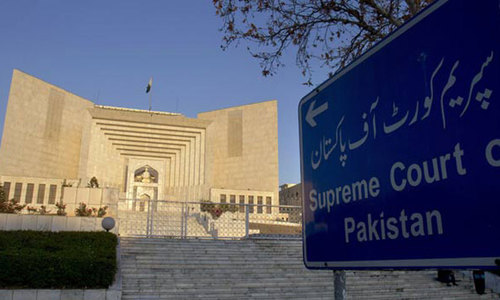
ISLAMABAD: The six departments tasked with deputing a representative each to the joint investigation team (JIT) that will probe the assets of Prime Minister Nawaz Sharif and his family have submitted lists of proposed names to the Supreme Court.
The apex court, in its April 20 judgement, had given the Federal Investigation Agency (FIA), National Accountability Bureau (NAB), Securities and Exchange Commission of Pakistan (SECP), State Bank of Pakistan (SBP), Inter-Services Intelligence (ISI) and Military Intelligence (MI) a week to submit names.
A day before the closing date, a source privy to the development told Dawn: “The Supreme Court has received names from the six government departments.”
Six departments, including ISI and MI, will send an official each to the probe team
The Supreme Court had directed the departments concerned to furnish three names each, from which one each would be picked by the Supreme Court to form a six-man JIT.
Soon after the announcement of the JIT different political parties gave diverse reactions. Some believed that the prime minister would be in trouble, while others said the probe team would just prove to be a “dry-cleaning shop” for the Sharif family.
On Monday, the military’s corps commanders had also pledged to ensure their transparent participation in the JIT’s proceedings to fulfil the confidence reposed by the Supreme Court.
The JIT is to be headed by a senior FIA officer not below the rank of additional director general who has firsthand experience of investigating white-collar crime. The team will consist of a NAB representative, a nominee of the SECP familiar with money laundering and white-collar crime, an SBP officer, and seasoned ISI and MI officials, to be nominated by their respective director generals.
Though the names of the officers have not been officially released, it is believed that FIA has furnished the names of three addition director generals, namely Wajid Zia, Ahmed Latif and Dr Shafeeq.
One of them will be picked by the Supreme Court to head the proposed JIT. Wajid Zia belongs to the police cadre and has also served in the Intelligence Bureau (IB), as did Ahmed Latif.
In its judgement, the Supreme Court had also outlined the scope of the proposed JIT, which would probe: how the Gulf Steel Mills in UAE came into being, what led to its sale, what happened to its liabilities, where did its sale proceeds end up, how did they reach Jeddah, Qatar and the UK, whether Hussain Nawaz and Hassan Nawaz in view of their tender ages had the means to possess and purchase the flats, and whether the sudden appearance of the letters of Hamad Bin Jassim Bin Jaber Al-Thani of the Qatar was a myth or a reality.
The court also asked how bearer shares crystallized into the four upscale flats in London, who was the real and beneficial owner of Nielsen Enterprises Limited and Nescoll Limited, how did Hill Metal Establishment come into existence, where did the money for Flagship Investment Limited and other companies set up or taken over by Hassan Nawaz and where did the working capital for such companies come from and where do the huge sums running into millions gifted by Hussain Nawaz to the prime minister drop in from.
The prime minister, Hussain and Hassan Nawaz, are also required to appear and associate with the JIT as and when required.
A special implementation bench of the Supreme Court will also be constituted to monitor the progress of the JIT.
Published in Dawn, April 27th, 2017