81
81

The Wall Street Journal on Tuesday quoted an adviser to Saudi Arabia’s minister of defence, who is involved in assembling the new alliance, as saying that the coalition could take action against rebel groups and militias that pose a threat to member countries — a possible hint at Houthi rebels in Yemen, who are backed by Iran.
Major General Ahmed Asiri, the adviser to the Saudi minister of defence, was further quoted by the Wall Street Journal as saying that the alliance is not specific in its objectives to confronting international terror groups like Islamic State and Al Qaeda.
The armed coalition was initially proposed as a platform for security cooperation among Muslim countries, and included provisions for training, equipment and troops, and the involvement of religious scholars for devising a counter-terrorism narrative.
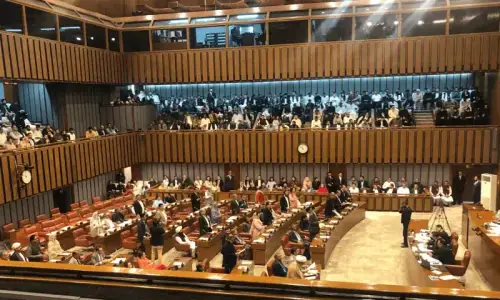
Since news of the alliance first surfaced, there have been concerns about its nature and how it may affect a pre-existing parliamentary resolution on Yemen passed unanimously by lawmakers calling for "neutrality in the conflict" in 2015.
Minister for Defence Khawaja Asif has time and again reassured the nation that Pakistan's stance on Yemen would not suffer due to this new-found coalition.
In the latest of these reassurances, on April 13, Asif told the National Assembly:"We will stick to our prerogative when it comes to Yemen, and the agreement we have will remain binding."
However, Asiri was quoted in the Wall Street Journal as saying that: "All countries will put effort into combating terrorism in the member countries, regardless of the nature of the terror groups. That is the main goal.”
He added, “Each country has its own expertise that it can contribute to the coalition.”
Addressing the Pakistan Tehreek-i-Insaf's concerns, voiced in the National assembly on April 13, Khawaja Asif had also said, "The alliance has not been formed yet, the countries have only discussed the matters."
"There will be a grand meeting of all the countries to be involved in the alliance in May, the formal alliance will be formed after that. The terms of reference formed in the meeting will be discussed in the parliament," Asif had added at the time.
"The Saudis wished that Raheel Sharif should head the alliance, whenever it is formed, and thus the matter was discussed. However, he will only ask for a No Objection Certificate (NOC) after all matters have been finalised," Asif said while he had the floor.
Iran’s ambassador to Islamabad, Mehdi Honardoost had registered his protest at Raheel Sharif's appointment as the head of the coalition and stressed that all important Islamic countries should come together to form a "coalition of peace" in order to resolve their issues "rather [than] forming a controversial military alliance".
It is important to note that Iran, Saudi Arabia's archrival for influence in the Arab world, has remained absent from the states named as participants, as proxy conflicts between the two regional powers rage from Syria to Yemen.