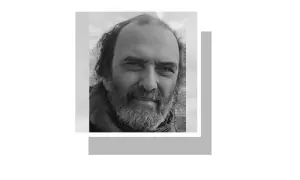
Muneer Niazi eulogised on his birth anniversary

KARACHI: To commemorate the birth anniversary of renowned poet Muneer Niazi, a literary sitting was held at the Anjuman Taraqqi-i-Urdu office, organised by the Anjuman’s youth committee, on Saturday morning.
Born in Hoshiarpur, India, on April 9, 1928, the commonly acknowledged date, though a researcher insists the year was 1922, Muneer was eulogised as one of the finest poets of the Urdu and Punjabi languages and a person who did not mince words while giving his opinion about someone or something.
Presiding over the event, poet Anwar Shaoor, well known for his quatrains and ghazals, remarked at the outset: “I am the kind of president here as is Mamnoon Hussain in the country.”
He briefly commented on the controversy triggered by Muneer’s reported remarks in a newspaper interview. The Urdu-language newspaper had quoted him as saying: “I do not recognise Karachi’s poets as poets.” Shaoor explained that Muneer had later clarified that though he really did not like certain poets from Karachi, he held several others in high esteem and appreciated their work.
‘He acknowledged that Karachi and Urdu gave him recognition’
Dr Fatima Hasan, poet and honorary secretary of the Anjuman, said Muneer loved both Karachi and its people. In that context she said Muneer’s second wife, Naheed, was from Lalukhet, where Muneer’s in-laws still lived.
Hayat Amrohvi Rizvi also said that Muneer Niazi acknowledged that Karachiites and Urdu had given him recognition as a poet. “The controversy was fuelled by the media,” he said.
Dr Hasan said her generation of youths in the 1970s was highly influenced by Muneer’s poetry. “As university students, we recited and quoted his verses probably more often than that of any other poet’s,” she said.
She said what set Muneer apart from other poets was the mysteriousness in his verses. “It’s an element of mystery that makes any piece of art a masterpiece,” she said. To illustrate her point, she mentioned the Mona Lisa, whose enigmatic smile she said had a mystery about it, making it one of the all-time greatest pieces of art.
She narrated how Muneer was brought up and how he deserted the British navy as a sailor while in England. His father died when he was a child and his uncle married his mother and nurtured the boy. Judging from his poetry, she said loneliness seemed to have haunted him throughout his life. “The word shehr (city) is also very common in his poetry. He had nostalgia for his place of birth and he repeatedly mentioned it.”
Syed Abid Rizvi, an architect, narrated anecdotes from his personal interaction with Muneer during his stay in Karachi at Fatima Hasan’s home, to highlight his wittiness and choice of words.
Noted fiction writer and columnist Zaheda Hina spoke on how she had close personal relations with Muneer Niazi’s family. She said he loved both his wives, and as a proof she said he dedicated one of his books to Sughra, his first wife, and another to his second wife, Naheed. She said Muneer influenced at least two generations. She also mentioned his favourite dishes when he visited their home in Karachi.
Wajid Jawwad read out verses from Kulliyat-i-Muneer and told anecdotes to highlight Muneer Niazi’s sense of humour. He said Muneer was very careful about appreciating poets’ verses. One poet was, however, so persistent to hear his appreciation that he went to Muneer’s home and touched his feet to know his status among the contemporary poets. Muneer’s frank remark about the seeker’s status, however, did not amuse him much.
Tanzeem-ul-Firdaus, head of Karachi University’s Urdu department, who arrived there a little late, also spoke.
A young fan of the late poet, Waqas Ahmed, said Muneer Niazi wrote ‘pure’ poetry, ‘poetry for the sake of poetry’, and did not try to drum up support for any particular ideology or group.
Yasmeen Sultana Farooqui, president of the youth committee of Anjuman Taraqqi-i-Urdu and a university teacher, thanked the guests.
Later a cake was cut to mark the birth anniversary of the poet.
Published in Dawn, April 9th, 2017