0
0

KARACHI, July 28: Sindh Minister for planning and development Syed Shoaib Ahmed Bukhari has proposed formation of a relief team to be headed by the Sindh Local Government Minister Mohammad Hussain and comprising MNAs and MPAs to take steps for resettlement, provision of food, clothes and other necessities of life to rain-affected people of the province.
Moreover, the minister in a summary to Sindh Chief Minister, Sardar Ali Muhammad Khan Mahar, has recommended Rs5 million each for badly- affected district of Badin, Tharparker (Mithi, Deplo) and Ibrahim Haidery and Malir in Karachi.
While Rs10 million provisional relief for Hyderabad is also proposed so that immediate relief could be provided to the affectees.
The minister said that the district governments and Nazims be issued directives to extend full co-operation to the relief teams of MNAs and MPAs so that maximum relief could be provided to the affected people through better co-operation and co-ordination of all relevant authorities.
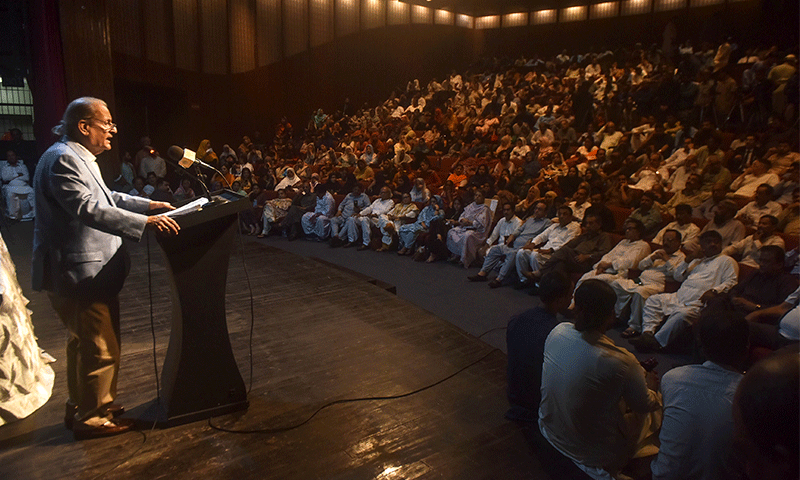
WORKSHOP: Speaking at a consultation planning workshop on proposed Early-Childhood Development Project at a local hotel, the minister said the government of Sindh is committed to improve the development needs of the children through health, nutrition and education activities.
He appreciated the assistance extended by the Asian Development Bank for organizing this workshop.
The minister said there was a growing realization that it was not enough to save children, but there was a need to improve the quality of life of the children by improving their thinking, reasoning, social and language skills.
As maximum brain development takes place within first three years, there is a need to provide maximum stimulation to assist in developing neural connections in the brain. This leads to better thinking capability which helps in learning and better school achievement, he added.
Shoaib Bukhari further said we realize that thousands of children die due to diseases, which are preventable. Sindh has the highest malnutrition (46 per cent) as compared to other provinces (33 per cent), indicating that children are not getting enough food to eat, thus, affecting their development.
Those who survive do not have adequate preparation at home to be ready for school. Thus, these children mostly do not go to school. It may be noted that in rural Sindh 60-80 per cent of children are out of school between the ages of five to nine years. Because of inadequate preparation at home, when children join school, they are not in a position to cope up with learning. — PPI