0
0
THATTA: Speakers at a consultative workshop organised by the Sindh Community Foundation (SCF) and Sindh Radiant Organisation (SRO) held here on Tuesday observed that Thatta district was vulnerable to natural disasters.
Government and international institutions should plan and implement measures for the survival and uplift of the district — already declared one of the poorest in the country — as local people could not help themselves in this regard.
The workshop on ‘Prioritisation of Sustainable Development Goals (SDGs)’ was held in collaboration with the United Nations Development Programme (UNDP).
Calling for a long-term strategy on risk-reduction management, the participants observed that the district, especially its coastal areas, were hit with extreme poverty.
Nasir Ali Panhwar, executive director of the Centre for Environment and Development, said that due to a number of reasons, Pakistan could not achieve eight Millennium Development Goals (MDGs).
He noted that there had been no consultation with communities and stakeholders to meet the goals.
He appreciated that now such consultations were being held in 24 districts of Sindh to seek input of stakeholders on setting priorities regarding 17 SDGs.
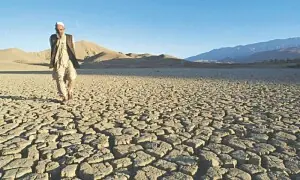
He told the participants that livelihoods of coastal communities in Thatta were threatened by sea intrusion, cyclones, droughts and floods.
He pointed out that the livelihoods, as well as energy needs, of the local communities were highly dependent on climate.
As a consequence of diminishing agricultural activity, local communities were forced to use trees and wild shrubs as fuel and energy source. He said there had also been extensive degradation of mangrove forests in this region due to multiple factors, including reduced flows of sweet water downstream Kotri.
Khuda Bux Behrani said that local government could play a vital role in implementing development projects at local level.
He said such projects should be part of the annual development programme.
Rehana Ali said that the SDGs were an ambitious set of goals and the 169 targets were defined and developed through an unprecedented dialogue among UN member states, local authorities, civil society, private sector and other stakeholders.
The other participants were Noor Mohammad Seria, Siddique Palijo, Sadiq Lakho, Qadir Bux Otho, Rahmatullah Chutto, Ibrahim Hajib, Ghous Pirzado, Dr Qamaruddin Baran, Niaz Memon, Qurban Ali and Kiran Memon.
Published in Dawn, March 29th, 2017