India bars Sartaj Aziz from talking to media in Amritsar
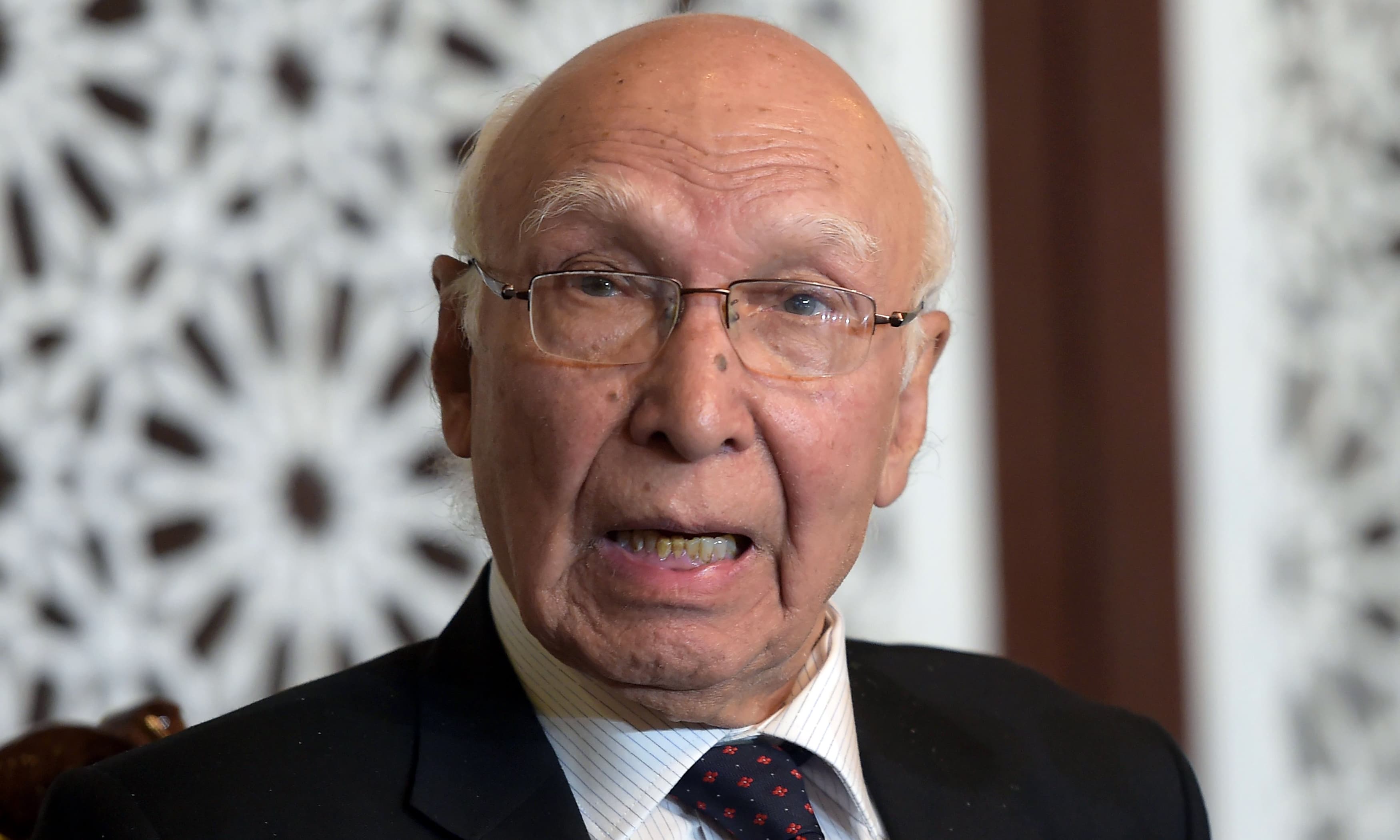


The Indian government on Sunday did not allow Adviser to Prime Minister on Foreign Affairs Sartaj Aziz to hold a scheduled press conference on the sidelines of Heart of Asia Conference, citing “security reasons”.
In sheer violation of diplomatic norms, the adviser was also barred from leaving the hotel premises and the media persons were not allowed to meet him in the hotel.
Furthermore, the Indian authorities stopped Pakistan's High Commissioner to India Abdul Basit to enter the Media Centre set up at the conference venue.
Arguments took place between High Commissioner Basit and security officials on his interaction with the Pakistani media persons.
Know more: Ghani, Modi lash out at Pakistan on terrorism at Heart of Asia moot in Amritsar
Later in the day, after returning from Amritsar, Aziz addressed a press conference in Islamabad and said, “Pakistan does not need to be pressurised in terms of counter-terrorism efforts.”
“We have done more in terms of counter-terrorism efforts in the last three years than any other country in the world.”
Aziz said we are now sharing our experiences of counter terrorism with the rest of the world.
Pakistan attended the conference to show solidarity with Afghanistan and the country’s commitment to peace and security in Afghanistan, he maintained.
‘No peace without resolution of Kashmir issue’
Pakistan's High Commissioner to India Abdul Basit said peace could not prevail in South Asia without the resolution of Kashmir dispute.
The lingering issue of Kashmir was the root cause of tensions between India and Pakistan and it must be resolved according to the wishes of Kashmiris, he said while talking to media on the sidelines of Heart of Asia Conference in Amritsar, India.
Pakistan, Basit said, had always favoured dialogue with India but on equal terms. He, however, added that Pakistan's desire for talks should not be misconstrued as its weakness.
He said Pakistan had been rendering sacrifices for last 35 years for durable peace in Afghanistan. The brunt borne by Pakistan (in the fight against terrorism) after 9/11 incident in the United States was known to all, he concluded.