Footprints: Playing with lives


 1
1


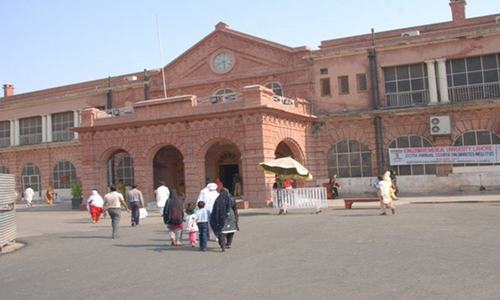
IT was around 6.30am and a group of policemen were standing outside the gate of Mayo Hospital, near the emergency department. Sanitary worker Emanuel walked by them to reach the outpatient department. Seeing the doors of the OPD closed, he heaved a sigh of relief: the supervisor was late. There was a bit of chill in the air and his fellow workers, standing near the boundary wall, were rubbing their hands together for warmth.
“It seems it will rain today,” remarked one of the sanitary workers while drawing the attention of the others towards their supervisor, who was parking his motorcycle on the footpath near the main entrance to the OPD.
Inside, there was not much waste to collect as the OPD had been lying closed for the past fortnight or so. The supervisor asked the sanitary workers to sweep the floor after sprinkling phenyl.
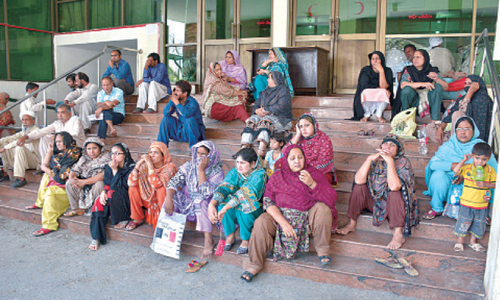
Accompanied by a young man, an elderly woman entered and sat down in a chair near the office of the additional medical superintendent. A diabetic, she comes down every week from Jandiayala Sher Khan near Sheikhupura to get her blood-sugar level tested and get free insulin. “Puttar, hartal khatam ho gae aay [son, is the strike over]?” she asks a paramedic. “Takreeban [nearly],” the paramedic replies with a smile.
The recent strikes by young doctors meant that scores of patients were denied treatment at outpatient departments and even at the emergency sections of public sector hospitals.
The young doctors had been locking up the OPDs of teaching hospitals to press the government to accept their demands, a tactic they resort to every now and then. The strikes pile on the miseries on patients, especially those coming from far-flung districts to Lahore and the other big cities of the province.
The denial of treatment of patients by doctors at public sector infirmaries was an unheard-of phenomenon before early 2008, when a group of junior doctors stopped working at Mayo Hospital after the attendants of a patient mistreated a lady doctor. The incident outraged the doctors and they formed the Young Doctors Association (YDA). The aim was to ensure the security of doctors and to safeguard their rights.
A central office-bearer of the YDA says initially the association served as a forum beneficial for young doctors. But it was gradually taken over by a group that wanted to fulfil its own selfish demands by presenting them as injustice to the community. “As a result, the young doctors, in their quest for justice, started ignoring their duties to the public — something that cannot be countenanced since it puts countless lives at risk,” he says, adding that there have always been “dissidents” in the YDA who “do not want to become part of the strikes but they are forced to stop performing their duties to build up the case for solidarity”.
A postgraduate trainee doctor of Mayo Hospital alleges that some professors were backing the YDA strikes. “These professors hardly visit their wards, which are entirely run by the young doctors. It suits them (the professors) for the administration to remain engaged with the young doctors and they can continue to run their private clinics,” he says. “Furthermore, there should be duty hours for trainee doctors. Working continuously after night duty at emergency wards has its impact. Overworked doctors will have attitude problems.”
“Yes, there are professors who are scared of the YDA,” the doctor continues. “Many office-bearers of the YDA have locked senior doctors in their rooms and misbehaved with them many a time, but no action was taken against the culprits.”
A senior fellow of the College of Physicians and Surgeons Pakistan (CPSP), Prof Dr Abdul Waheed, says Pakistan is the only country where doctors get hefty amounts as stipends during postgraduate training. “After becoming specialists, their first preference is to go abroad,” he says.
“Those who cannot do so start practice at some private clinic instead of serving at a public health facility. The government should devise a mechanism to make it mandatory for a doctor, who has completed his specialisation at public expense, to serve for a certain period at a public hospital. The strike phenomenon can be controlled by senior teachers, appointed supervisors by the CPSP for the trainee doctors. The CPSP rules empower a supervisor to declare a candidate ineligible for training on account of misconduct.”
In 2011, doctors in Lahore marched in protest for a salary raise. This ripple effect went all the way to Karachi and Hyderabad and the strike went beyond 37 days, resulting in several deaths. The YDA’s sit-in in 2012 went beyond eight days and there was no one at the OPDs.
In 2013, a crackdown in Rawalpindi involved the association withdrawing its workers and services from emergency rooms, gynaecology wards and intensive care units in a local DHQ resulted in the death of a patient brought in to be treated for tuberculosis.
In 2014, doctors protested against the sacking of 12 of their colleagues and staged a sit-in outside the hospital until their termination of service order was revoked. In April 2016, the YDA prevented senior doctors from attending to their patients at Sargodha DHQ, which resulted in the death of two minors.
During the ongoing strike, a cardiac patient and a minor girl died at Mayo Hospital after being denied treatment by the protesting doctors.
Published in Dawn, November 13th, 2016