0
0
RAWALPINDI, Dec 12: The World Health Organization (WHO) will help the district government in establishing city health unit to streamline health issues in the district.
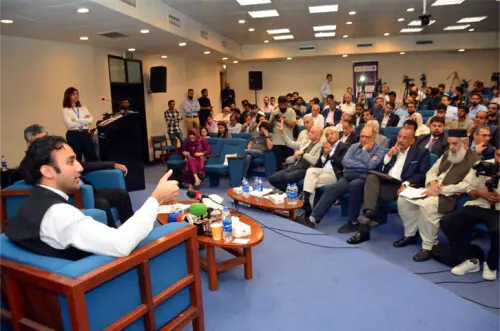
This was stated by WHO country representative Dr Khalif Bille Mahmud during a meeting with District Nazim Raja Tariq Kiani here on Friday.
The city health unit will be established close to the district Nazim secretariat to oversee the coordination of different district government departments with respect to the health issues.
The district government, Mr Kiani said, did not look at the health sector from the mere therapeutic, preventive or curative point of view. But, it also takes into consideration all other factors, including good roads, quality water, better environment, proper schooling, agriculture, sewerage system etc., as they have important bearing on the health of the citizens.
Justifying the establishment of the city health unit, he said it was felt that the district’s health department could not alone be sufficient and would have to be supported by another department.
It may be recalled that the WHO had recently agreed in principle to make Rawalpindi a partner city. The World Health Organization conference at Kobe (Japan) had also recommended that Rawalpindi’s basic development needs module should be taken as an example to follow.
The WHO and the district government further agreed to initiate the development of slums project on self-help basis through community participation.
Urban slums constitute 24 per cent of the district’s population. Union Council Rehmatabad was chosen for the launch of the project.
The factors that contributed towards the selection of this UC were active local leadership, homogeneous atmosphere and motivated community.
The government’s role in the project will be supportive for capacity building of the local community, whereas UN’s share will be technical.
The meeting also approved extension of school health service to seminaries. The Madressah Health Plan will cover three aspects: comprehensive health checkup of students, health education and capacity building of the Madressah administration to handle the health issues of their students. The project will also work towards improvement in the living conditions at seminaries to improve students quality of life.
The district administration will rope in the district peace committee, comprising leading clerics, to undertake the project.
A four-member committee, comprising WHO and district health department officials, has been constituted to oversee all the projects.