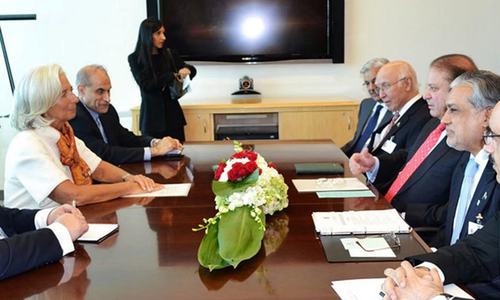
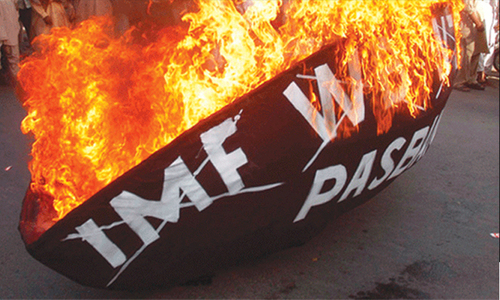
As Prime Minister Nawaz Sharif’s increasingly embattled government sharpens its knives to block Imran Khan’s promised storming of Islamabad on Nov 2, Monday’s visit by the IMF’s managing director is set to be celebrated as a grand recognition of Pakistan’s economic success.
In reality, however, neither Christine Lagarde, the former French finance minister who currently heads the Washington-based lender, nor the ‘baboos’ of Islamabad’s finance establishment, led by Finance Minister Ishaq Dar, can just gloss over the pitfalls confronting the country’s troubled outlook.
With more than half the population in distress because of a crash in agriculture and almost a third living below the poverty line, Pakistan’s future does not seem to be promising.
Meanwhile, falling exports continue to highlight the economic woes confronting the nation. Such stark challenges notwithstanding, the government is in no mood for a radical shift of priorities, meaning that it should shift its focus from glitzy road and transport projects to meeting the needs of an increasingly stressed populace.
Even the recent end of yet another loan from the IMF disbursed over the past three years has failed to tackle the most pressing challenges surrounding ordinary households. Exactly what tangible benefits will the IMF managing director’s visit bring to the country remains a central, valid and pressing question.
The only thing to cheer about in this instance is that the IMF has completed a loan to a country, albeit through many waivers. This sharply contrasts with Pakistan’s history of broken promises, number fudging and recurring failure to meet financial targets agreed upon with lenders. The prospect of Pakistan’s return to the Washington-based lender remains a very real probability.
As this newspaper pointed out recently, of the past 27 years only six have been spent by Pakistan outside an IMF programme. The fundamental logic behind this about to be celebrated relationship is therefore just one: ‘Borrow, borrow, borrow’ to ‘Spend, spend, spend’ without tackling fundamental challenges.
Policymakers like Dar, recently honoured as South Asia’s best finance minister by a trade publication but only after alleged hefty official payments to its commercial benefit, are eager to proclaim that the economy is booming. Matters like a significant lift to liquid foreign reserves and a higher economic growth rate than three years ago stand central to his claim.
Even an unexpected blessing for Sharif’s government has failed to tackle some of Pakistan’s deepest challenges. He was fortunate enough to preside over Pakistan as global oil prices crashed, ending with a significant fall in the annual oil import bill.
Tragically however, on matters like fixing a key problem in revenue collection by roping in many more taxpayers to one of the world’s worst performing collection systems, there has been limited headway. Hardly one per cent of Pakistanis pay an income tax while the system lets many who deserve to be locked virtually go scot free.
And Lagarde’s visit takes place just weeks after the annual deadline for filing income tax returns was extended by a month, reportedly on the pretext of many taxpayers having been in Saudi Arabia last month for performing Haj. The change has aroused fresh scepticism over the ruling structure’s ability to tightly enforce its writ — the deadline was extended repeatedly just last year too due to a reported technical glitch in a supposedly landmark e-filing system.
Lost opportunity
Although Ishaq Dar gets a pat on the back frequently for his IMF-assisted success, critics like Salman Shah, a former finance minister, describe the just-ended IMF programme as a “lost opportunity”.
In an interview with this writer he concluded that “the IMF programme has not solved any of Pakistan’s problems; it just delayed” the pressure to deal with them.
And a former governor of the State Bank, who spoke to this writer, wondered if Ms Lagarde or any of her colleagues can convince Pakistanis that their country no longer needed to remain a regular IMF client. “Can the IMF look us in the eye and say `we have laid a foundation on which you (Pakistan) can build upon’. Is this a sustainable outcome?”
It is still possible that if Sharif manages to complete his five-year term, which ends in 2018, there will be a race against time to fulfill the promises of fixing Pakistan’s electricity and gas shortages, all to win votes. But a persistent jacking up of energy tariffs in order to generate money for new projects cannot cure an ailing system.
Short of taking chronic problems like corruption head on, there is bound to be limited progress, especially in the tenure of a prime minister dogged by questions over enormous amounts belonging to his children and disclosed by Panama leaks. Any anti-graft initiative launched by the government is bound to face popular resistance on the ground that the top man must come clean first.
Ultimately, the Lagarde trip will leave behind a compelling question: was the IMF managing director’s visit mainly intended to keep Pakistan’s lending relationship ongoing or to mark the country’s graduation to ultimate economic independence?
Published in Dawn October 24th, 2016