Abdul Sattar (sitting) is an electrician and lives in Rizvia in Karachi. Along with his brother Mohammad Irfan (2nd from left) who is a motor mechanic, and their sons, he has been making tazias for over 40 years. The family is originally from Bharatpur in Rajasthan, India.
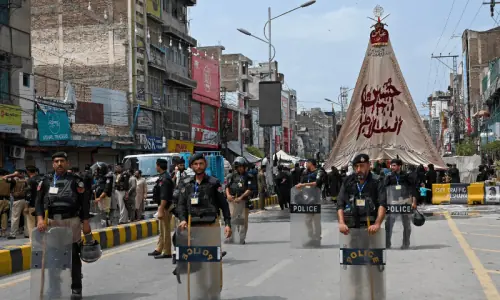
In a region that has become known for its religious and sectarian conflict, tazias — or representations of the tombs of the imams, which form part of elaborate theatre of Muharram processions — are a reminder of a more harmonious time. Lovingly constructed with great devotion and attention to detail, tazias are often built by Barelvi Sunni Muslims, although many Shia Muslims are also involved in the tradition. In India, one can still find towns and cities where Hindus and Sikhs continue to make tazias. Historians trace the tradition of the tazia to the invasion of northern India by Taimur (Tamerlane) in the 14th Century. Shahid Ali Naqvi argues in his book, Azadaari, that the need for a tazia arose when Taimur was unable to take his army to Karbala for their annual trip. As a conciliatory gesture, he arranged for a model of the shrine to be built from khak-i-shifa (clay of Karbala) transported all the way from Iraq to the subcontinent.
The frame of the Sattar family’s tazia is made from bamboo; the tazia costs around 25,000 rupees for which the family save up every year. - Photos by Tahir Jamal/White Star
As with many mourning rituals observed during Muharram in the subcontinent, tazias are unique to South Asia; Iran and Iraq do not have them. Contemporary tazias are a far cry from the simple structures made initially from mud. They vary in size – from small enough to be carried in the hand to ones that go up to 50 feet — and are intricately carved and decorated, reflecting the makers’ hard work and passion. The decorations of the tazias also often reflect the craft the region is known for. In Chiniot, renowned for its beautifully carved woodwork, for instance, one tends to find tazias made from engraved wood. Many are also an intergenerational effort, often with generations of families coming together to make the tazias.
For this Shia family, the making of the tazia is an extremely devotional act. They get together at the Syed Mohammad Tufail Shah Dharampura Imambargah, near Dharampura’s main market in Lahore, to assemble their tazia. It took them more than a month to make this tazia from wood and cardboard. - Photo by M.Arif/White Star
Mohammad Qadeer shows family photos of the tazias they made in previous years while his friend, Abdul Sattar (on the left) stands next to him. Qadeer, also known as Kallu Bhai, migrated to Karachi from India and has been making tazias from the age of 15.
Abdul Sattar’s family on M.A. Jinnah Road moving their tazia towards the Native Jetty Bridge in Karachi in 2009. - Photos by Tahir Jamal/White Star
Minute detailing goes into the construction of tazias. Here the beads that will add sparkle to the tazia are being sorted in Lyari, Karachi.
Making tazias is a tradition that has been passed on from one generation to the next in this Lahore-based family hailing originally from Kakrawala, India. Whatever profession the family members pursue during the day, as Muharram approaches, finishing the tazia is of the utmost priority. The family has so far spent 50,000 rupees on this particular tazia. While most of the structure is almost complete, the family is busy putting in the final touches to the tazia made of glass, cardboard and paper. It is being assembled at the Kakrawala Imambargah. - Photo by Tariq Mahmood/White Star
Making tazias is a tradition that has continued in this Lyari family for generations. The family from Lyari is not only known for their passion for making tazias, but also their superb skills, and has even won a prize for their tazias. - Photos by Fatimah Ali/White Star
Images on Sunday takes a look at what happens behind the scenes and meets some of these families. — Photos by White Star
Published in Dawn, Sunday Magazine, October 9th, 2016
Both sides accuse the other of violating the truce that was supposed to halt the conflict in April, yet neither appears willing to abandon negotiations altogether.
Though the JAAC’s demands are open to scrutiny, banning any political organisation — as long as it remains committed to peaceful activism — is undemocratic.




 0
0