0
0

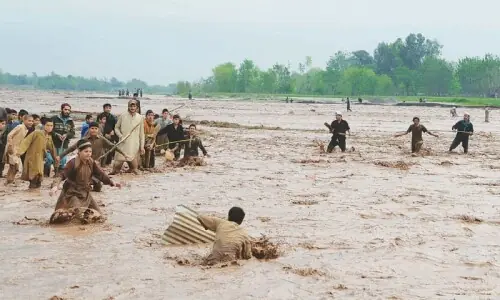
ISLAMABAD: During a public talk on Tuesday, Ambassador Khalid Mahmood said Pakistan’s climate and ecosystem are under severe stress, which is evident from the frequency of natural disasters.
Mr Mahmood, the chairman of the board of governors of the Institute of Strategic Studies (ISSI), was speaking at a talk on ‘Climate Change, Nuclear Disarmament and Humane Global Governance’ at the institute.
He said climate change is intimately linked to the disastrous impact of nuclear weapons. In the 1980s, several studies were carried out on how the use of nuclear weapons and ‘nuclear clouds’ would impact climate change. “In this context, we need a global governance system in order to avert any such scenario where nuclear weapons are used,” he said.
Guest speaker Prof Dr Richard Anderson Falk, professor emeritus of International Law and Princeton University and former UNHRC special rapporteur on Palestine, said the topic was an overarching subject and highlighted the shortcomings of the international arrangement that caters to existential threats to humanity.
He said problems between states were solved in a few basic ways – including through a multilateral consensus among states to serve humanity. However, Dr Falk added that the international system or structure does not have the adequate qualities or the framework to uphold these global values.
“The best it could do was what happened in the Paris agreement,” he said, adding that the government should take responsibility either of who generates these problems or who solves them. He said one of the problematic aspects of climate change is the degree of harm caused by it, which is concentrated and affecting communities who are not responsible for generating the problem.
Dr Falk also emphasised the failure of the United Nations system to provide a plan and approach to solving common challenges to humanity.
Another guest speaker, Dr Hilal Elver, a research professor and global distinguished fellow at the University of California Santa Barbara LA Law School, posed questions on the difference between human and humane global governance. “The fear factor is very important in mobilising societies to force their governments, and this fear which regards to nuclear weapons and climate change is one stark distinction.”
She added that the global economy, corporate interest and the private section were not very important factors in nuclear disarmament, but were in the climate change scenario. She said that while the concept of security during the Cold War was based on territorial defence, that has now changed to human security – which is the human part of global governance and security.
Published in Dawn, August 31st, 2016