0
0

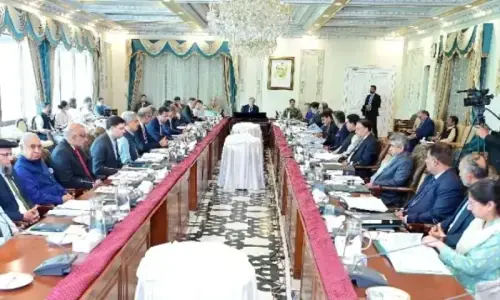
ISLAMABAD, Nov 20: President Gen Pervez Musharraf has assured that the LFO issue would be resolved very soon as he has decided to get personally involved in the process of government-MMA negotiations.
Talking to a group of editors and senior journalists here at the presidency on Thursday, the president said, if both sides show flexibility, the matter could be resolved to the satisfaction of all.
He, however, added that the desk thumping would still continue as according to him some of the opposition groups received their instructions from abroad.
“And you know what are their objectives,” he added.
“We will leave the LFO behind as the government advances into the second year of its tenure,” he added.
Insisting that his uniform was not the main issue, he said there were seven other issues which he felt could be resolved as in his view there was a lot of room for compromise.
He said there was no need for the two sides to make any fundamental compromises on their respective principles but he felt the two can certainly amend their respective strategies to reach a settlement without having to abandon these principles.
“For example, I myself subscribe to the principle that the offices of the president and the army chief should not be held by one man while the opposition disagrees with the idea of NSC and 58(2)b on principle. In my opinion without giving up these principles we can come to an agreement on these contentious issues by simply developing new strategies for achieving the same objectives,” the president elaborated.
Answering a question the president said that Benazir Bhutto and Nawaz Sharif have no place in Pakistan and hinted that perhaps the latter would return home in three years’ time, “at the moment both are having the best of their time abroad.”
He said governance and politics were two different matters, “despite the political hurdles in the way the government can still pass bills and make legislation, sustain the economic growth, maintain macro-economic stability and keep improving the efficiency of corporations.”
He did, though, concede that poverty had gone up while investment needed to be accelerated quickly.
The president appeared extremely concerned about the issue of religious and sectarian extremism and said: “This is one area which will drown us. It is senseless.”
He said with the passage of time the world has started suspecting Pakistan and a perception that the president himself was supporting extremists and terrorists was gaining widespread acceptance in the world
He warned that Pakistan will suffer from sanctions and “they may even start bombing our tribal areas,” if this perception is not removed urgently.
He said Pakistan could lose a market of a billion dollars if the European Union, believing that Pakistan was involved in spreading international extremism, withdrew by way of punishment the trade concessions it had offered to Islamabad.
He said he was shocked when during his recent visit to China the Chinese leaders informed him that Pakistan had provided sanctuary to Chinese extremists operating against Beijing’s interests.
He said he was waging a lone war against these extremists and found others who have equal if not more stakes in a peaceful and progressive Pakistan, reluctant to come forward and fight the menace head on.
“We must all help stop this menace and condemn it publicly. The politicians and the media should be very active on this front,” he added.
In his opening remarks the president said that he had identified three areas of concern for Pakistan in the days ahead with religious extremism being on top of the list followed by provincial harmony and political stability.
He said political stability could be achieved by resolving the LFO issue which he thought was ‘doable’, and religious extremism according to him needed a national effort in which he wanted all those who are sincere to Pakistan to join in.
He appeared equally concerned about the growing provincial disharmony, especially the state of affairs in the province of Sindh and seemed disappointed by the reluctance of members of Sindh government to come forward and try to correct the situation.
He agreed that there was a lack of trust among the people of the province and acknowledged the existence of genuine reasons for this but felt disappointed at being held responsible for the mistakes of the past government.
He vowed to set things right in Sindh and called on politicians from all sides to work for improving the situation, especially on the issue of water reservoirs.
“Please do not politicize projects which are being launched for the good of the province,” he appealed.
He appeared extremely unhappy with the law and order situation in Balochistan for which he blamed the Sardars of the province squarely.
He said the writ of the government extended only to 10 per cent of the area in the province and the rest of the 90 per cent was being ruled by Sardars who he said were fleecing provincial and federal governments.
Promising to sort out the culprits, he vowed to accelerate the development work in the province and at the same time he sketched a plan under which he proposed to broaden the writ of the government district-wise gradually while at the same time making genuine law enforcement agencies, like the police, frontier constabulary and the army solely responsible for enforcing this writ in the province. He said he wanted to see the Police Act implemented in its totality.
Earlier, he said Pakistan was at a crossroads at the moment, with one route leading it to the road to prosperity and the other to marginalization.
He said if we stay the course and continue to improve our economy and make the best use of our geopolitical position, we will benefit immensely, but if we do not mend our ways and continue to tolerate religious extremism and sectarianism we will be marginalized completely.
He said he has decided to gradually merge the tribal areas with the settled areas of Pakistan, “we are making progress on this front.”
He warned all those extremists and terrorists who have found sanctuary in the tribal areas to get out otherwise he said the government would forcibly expel them.
He also expressed his disappointment with the media and said that there was no truth in the stories suggesting that China has refused to help us build Chashma nuclear power plant II.
“It is the other way round. China is ready to finalize the deal but we are looking at other more cheaper options, like hydro-electricity and coal-fired power because of our resource constraints,” he added.
He said China knew very well why India was building a military base in Tajikistan implying that it was part of a scheme to encircle China and that it was not being set up against Pakistan.
He also refuted a London weekly’s story which had said that Pakistan was losing more than India because of the ban on overflights through the airspace of the two countries by their respective aircraft.
Referring to the newspaper stories about the scuffle between a police man and a driver of a general over what was purported to be car with tinted glasses, he said in this story too the media went with incomplete facts and half truths.
He even suspected some kind of a conspiracy behind the affair as according to him it was very strange that immediately following the arrest of the police man in question a foreign radio station was relaying his interview.
He also defended the induction of armed forces personnel in civilian jobs and said all appointments have been made on merit, “we first try to find the right person in the civilian services and only when we fail to find a suitable officer then alone we appoint one from the armed forces, but his selection is done purely on merit,” he added.
Referring to the Javed Hashmi case, he said he does not mind attacks on his person and criticism directed at him, but he would never tolerate attempts to create dissension and discord among the armed forces. He hinted that the letter could have been written by some retired disgruntled major, but thought it was wrong on the part of Javed Hashmi to have gone public with it.
Mentioning media reports about alleged presence of Taliban in Pakistan, he said every Pushtoon or Afghan with a beard cannot be regarded as Taliban. In his opinion only those people who were associated with the Mullah Omar’s defunct government in Kabul can be regarded as Taliban and therefore in his opinion, the media should learn to make distinction.
“If anyone has any information about the actual Taliban’s whereabouts, they should inform the government so that they are apprehended and handed over to the Afghan government,” he added.
He said he was also embarrassed by the frequent mention of Dawood Ibrahim in the Pakistani media suggesting that the Indian fugitive was living in Pakistan.
Such wild charges, he said, only brought a bad name to the country and undermined its international image.