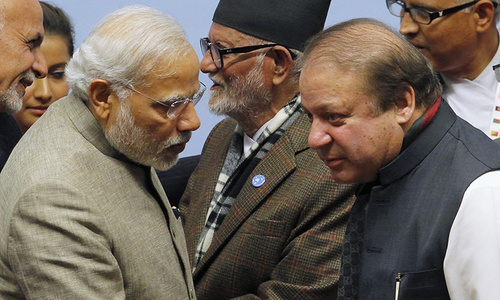
LAHORE: Pakistan Tehreek-i-Insaf (PTI) chairman Imran Khan on Thursday lashed out at premier Nawaz Sharif and his Indian counterpart Narendra Modi for holding a secret meeting in Kathmandu last year, and called both leaders 'cowards'.
"Leaders do not need to hold meetings in secret. They do not need to lie; in fact they must be credible," said the PTI chief, addressing a leaders' conference in Lahore.
A book called 'This Unquiet Land — Stories from India’s Fault Lines,' by veteran TV journalist Barkha Dutt, alleges Nawaz and Modi vanished for an hour to hold a quiet meeting ─ which was so secret that it was deniable ─ on the sidelines of a regional summit hosted by Nepal last year.
But both the Pakistan and Indian governments via official statements rubbished reports of such a meeting, terming news reports on the matter "baseless."
Related: Pak, India rubbish Nawaz-Modi 'secret meeting' reports
Imran Khan said leaders must be able to "sell their vision to their people." He went on to say that India and Pakistan hold immense potential to benefit from bilateral trade, citing the example of the European Union where the concept of borders is non existent.
'Prioritising vision'
Imran Khan said because the subcontinent is one of the poorest regions in the world, our leaders need to "re-prioritise their visions," adding that there was a severe lack of vision among leaders of both countries.
The PTI chief said ending poverty in the region should be a top priority for leaders of the region.
"Through improved trade relations between Pakistan and India, and by implementing policies that aim to end poverty and resolve disputes like the Kashmir issue, our leaders can create peace in both countries."
"The few extremists who resist, will always resist and need to be marginalised through public opinion," he added.
KP initiatives
He cited the example of PTI's new commercialisation efforts in Khyber Pakhtunkhwa (KP) where his party leads the government.
In an experiment, he said the PTI 'commercialised' 60 rest-houses that had an annual expense of Rs20million each, which was drawn from taxpayer money.
"Within six weeks, the guest-houses made Rs4million, and all profits are being channelled back to the local communities, to be spent on health and education."
KP is now considering a larger-scale plan for the management of state-run guest-houses, and a model to commercialise all of the province's guest-houses is in the works, said Imran.
In addition, Imran Khan said that to counter the damage caused by illegal timber-mafias (who have cut down over 2,000 million trees in the country) his party has introduced the 'Billion Tree Plan' in KP.
"Pakistan is among the top ten countries predicted to be most adversely impacted by climate change," Imran Khan explained.
Under the 'Billion Tree Plan,' his government aims to plant a billion trees within the next 5 years, of which 6.4 million trees have already been planted, he said.
"The initiative employs local villagers, who are given a small sum to grow their own nurseries instead of buying plants from government nurseries."