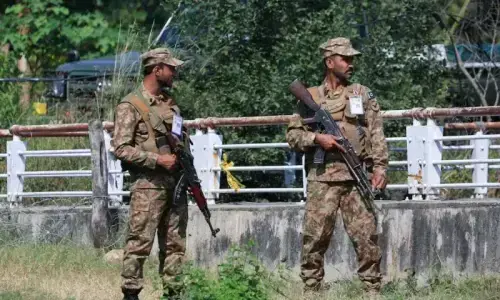


A US investigation into a strike on a charity-run Afghan hospital cited mistakes so “reckless” that observers said they left open the unsettling question of whether those involved had ripped up their own rulebook in a chaotic effort to take out the Taliban.
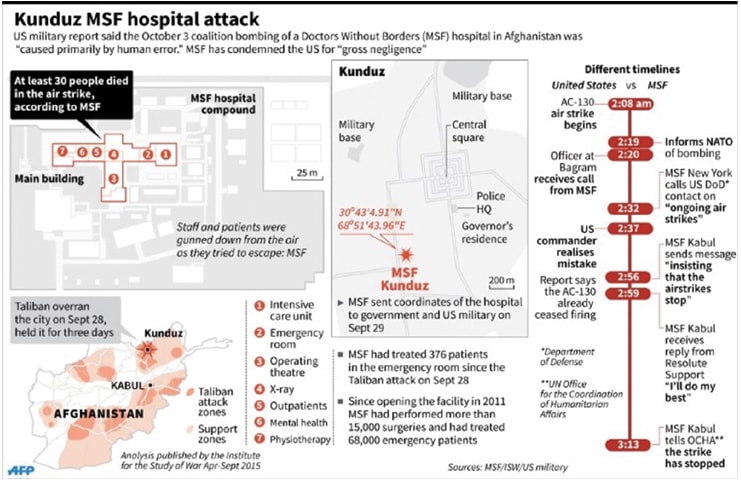
The Oct 3 strike on a Doctors Without Borders (MSF) hospital in Kunduz was “primarily human error ... compounded by systems and procedural failures”, said General John Campbell, the US commander in Afghanistan, as he announced the results of the investigation this week.
The strike came after a resurgent Taliban briefly captured the northern provincial capital in their biggest military victory since they were toppled in 2001.
But a catalogue of errors Campbell listed that ultimately resulted in the AC-130 gunship firing on the hospital went against safeguards that had “long been standard operating procedure”, Kate Clark of Afghanistan Analysts Network said.
“The question remains whether the disregard of these procedures was intentional,” she wrote, underscoring the need for an independent international inquiry into the strike which killed 30 people and which observers have said could amount to a war crime.
Analysts have also pointed to unanswered questions in the report — particularly regarding what Afghan forces on the ground were doing throughout the attack — and said some of the systems failures described were beyond comprehension.
Holes in the narrative
Among the claims made by Campbell that analysts stumbled over was his statement that targeting systems on board the AC-130 had been “degraded” after the plane changed its flight path believing it had been targeted by a missile.
This reduced the crew — who had taken off early, without a proper mission brief or the no-strike list — to searching for the “closest large building” near to where the AC-130’s systems were telling them to fire.
Michael Koffman, a military expert at the Wilson Center in Washington DC, said the claim defied understanding as the crew would only have had to make simple changes to account for the shift.
“They failed to adjust the knobs,” he said.
At any rate, Clark said it was hard to believe the crew did not know that the building they had in their sights was the MSF hospital, “a highly distinctive building ... the only one lit up at night in a city without electricity”.
Campbell also cited “confusion” at headquarters at Bagram, where officials failed to realise that the gunship crew were preparing to fire on the hospital, exacerbated in part he said by a technical failure aboard the plane that left it without video or electronic communications.
But Koffman argued that was no excuse for error, criticising the over reliance on technology.
And Clark said his admission that headquarters failed to check the strike did not target a protected site amounted to a systemic breakdown that “extended beyond those immediately involved in the operation”.
The mistakes, she said, were “of a far more serious nature than Campbell would have us believe”.
Afghan eyes on the target
Just as important as what is included in the summary report is what is left out, argued London-based military analyst J Chacko.
According to the summary, it took US officials nearly half an hour to realise they were destroying the wrong target.
“What was happening during the 29 minutes of the attack?” asked Chacko, noting the summary also made no reference to any cockpit or audio recordings that, according to various US media reports, may exist.
Afghan special forces on the ground “would have had eyes on the target”, he said, but the summary was “particularly thin” on what they were doing during the strike.
It is possible, said one regional security analyst who asked not to be named, that Afghan forces did not rush to tell the US they were attacking the wrong target “because they believed, wrongly or rightly, that Taliban were inside ... and they needed to be taken out”.
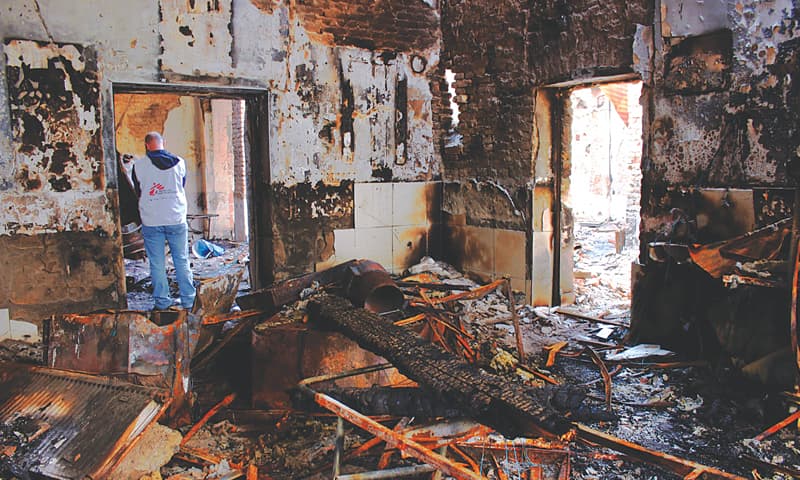
MSF’s own report stated the strike — which it said, contrary to the US investigation, lasted nearly an hour — left patients burning in their beds with some victims decapitated and suffering traumatic amputations, and cited witnesses who described the plane strafing those fleeing the hospital from above.
The charity has repeatedly called for an independent international inquiry into the strike.
“It appears that what happened on the night of Oct 3 amounted to a throwing away of the rulebook,” wrote Clark, who slammed Campbell’s claim that the US military inquiry had been independent because it was carried out by generals who were not under his command.
It is not surprising that the calls for independent investigations continue. Those involved in the attack have been suspended pending “standard military justice”, General Campbell said.
A full 3,000 page investigation report is due to be released to the public, officials have said — once it has been redacted.—AFP
Published in Dawn, December 1st, 2015