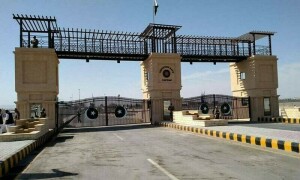
KARACHI: Sindh Chief Minister Syed Qaim Ali Shah has approved a Rs12.6 billion project for the rehabilitation of the Sukkur barrage that he described as the lifeline of the province’s agro-economy.
Under the project, the flood capacity of the barrage will be increased by 150,000 cusec and its system will be modernised so that it can be run from a control room.
CM Shah, who was presiding over a meeting on Friday, directed the irrigation department to conduct a silt control study.
The meeting, which was attended by senior finance and irrigation minister Syed Murad Ali Shah and a team of British consultant Ian Heijne besides some top bureaucrats and irrigation experts, was held at CM House.
The project was approved on a recommendation of the irrigation department after a briefing on three available options related to the Sukkur barrage rehabilitation was given by the British consultant.
Mr Heijne said that under the project, the barrage structure would be strengthened and made safe; flood capacity would be enhanced from the existing 1.15 million cusec to 1.3 million cusec; and operation and management of the barrage system would be ensured.
Earlier, he briefed the meeting about details of the three proposals costing Rs12.6 billion, Rs25.2 billion and Rs26.3 billion, respectively, for the rehabilitation of the Sukkur barrage.
Under the Rs12.6bn project, the flood capacity was proposed to be enhanced by 150,000 cusec, while the flood capacity according to the other proposals costing Rs25.2 billion and Rs26.3 billion was to be increased by 300,000 cusec, the meeting was informed.
Mr Heijne said the existing river training works would be retained under the first option, while the river training works would be modified to increase river width under the second one. Under the third option, he added, the settling and opening of all the 10 closed gates would be improved.
Irrigation Secretary Zaheer Hyder Shah said that each of the three options given by the consultant after going through a four-year study has a different impact. “But we need to discuss all the three options threadbare,” he insisted.
Water expert Idress Rajput was of the opinion that as the barrage structure was strong enough, the first option was the best. He recommended the chair to approve the Rs12.6bn rehabilitation project.
Another irrigation expert Bashir Dahar said it was the SOP of the barrage management that effective flushing, closure of headworks during large flows are to be made. “If proper procedure is adopted, then every problem would be solved. As far as increasing the pond of level of the Sukkur barrage is concerned, it has to be approved by the chief minister even if an inch is increased,” he said.
Another water expert Ali Gohar Shah said that if pond level of the Sukkur barrage was increased, it would cause seepage in both the banks. He suggested to the meeting that an alternative arrangement be adopted.
The irrigation minister, however, recommended to the chief minister that the first option be approved so that the flood capacity of the Sukkur barrage was enhanced to 1.3 million cusec. “We do not need to increase its flood capacity to 1.5 million cusec, because the flood capacity of the Guddu barrage is 1.2 million cusec,” he argued.
The irrigation secretary said the first option included different works such as dredging and excavation for silt disposal, civil works for repair and rehabilitation of barrage and canal head regulators, change of gates and mechanical works, modernizing of monitoring and control system, new buildings for monitoring and control, a laboratory and a workshop.
Chief Secretary Siddique Memon said that almost all the issues and problems of the Sukkur barrage had been covered under the Rs12.6 billion proposal.
“If the pond level of the barrage is increased it will improve discharge in canals of the left bank,” he added.
Published in Dawn, November 28th, 2015