43
43
DHAKA: The execution of two Bangladeshi opposition leaders for war crimes appears to have cowed rivals of Prime Minister Sheikh Hasina, but critics said her success comes at the cost of free discourse and the calm is likely to be short-lived.
Political analysts and opposition leaders warned that the executions sent a signal that violence is the only political tool that works. The shock felt by an opposition which has already suffered mass arrests may be replaced by further bloodshed.
Ali Ahsan Mohammad Mujahid and Salahuddin Quader Chowdhury were hanged on Sunday for crimes against humanity during the 1971 war to break away from Pakistan.
Read: Bangladesh executes 2 opposition leaders despite concerns
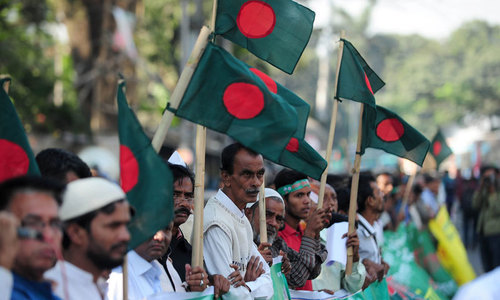
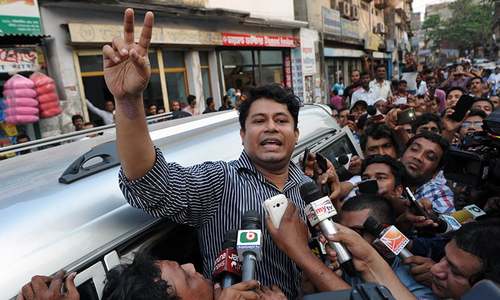
Protests against the hangings were muted. A general strike was called on Monday by Mujahid's Jamaat-e-Islami party, but there were no processions in Dhaka to back the strike and the day was largely peaceful in a country when strikes often turn violent.
Chowdhury was a legislator in former premier Khaleda Zia's Bangladesh Nationalist Party (BNP).
"Hasina's popularity has soared because of the overwhelming support of the people in favour of trials and execution of war criminals," said H.T. Imam, Hasina's political adviser.
"The policy of the government is zero tolerance against terrorism or violence, be it Islamist or any other kind." Badiul Alam Majumdar, secretary of rights group Citizens for Good Governance, said Hasina had been getting stronger because she did not have any visible opposition.
"The absence of democracy only creates room for extremism," he said.
Muslim-majority Bangladesh has seen a rise in Islamist violence in recent months, with two foreigners and four secular writers and a publisher killed this year.
Just a few hours before the Supreme Court rejections of the opposition leaders' appeals on Wednesday last week, an Italian priest and medic was shot and wounded in the latest attack on foreigners in Bangladesh.
The militant Islamic State (IS) group has claimed responsibility for the attacks on the foreigners, but the government has blamed the rising violence on political opponents.
Tensions are high in Dhaka. Foreigners avoid walking in the streets, even in the relatively more secure Gulshan diplomatic area.
The crucial $25 billion garment export sector has been nervous. Last month, executives from global clothing giants H&M, Inditex and Gap cancelled trips to Dhaka after the killings of foreigners.
Last week, some writers due to attend the Dhaka literature festival skipped the event. Foreigners who came drove in and out of the venue, where security was beefed up.
Some Bangladeshi's feel that the executions of people convicted of war crimes provides some sense of justice, but they said the uncertainty of what fundamentalist groups might do in retaliation was scary.
"The fears of public intellectuals, opposition political leaders and ordinary people will increase," said Ataur Rahman, chairman of the Centre for Governance Studies in Dhaka.
Islamists have denounced the trials as a politically motivated campaign. Abul Barkat, an economics professor at Dhaka University, said backlash from such groups had become more likely after the executions.
Muhammad Osman Farruk, a BNP leader, called the increase in violence "ominous".
"This has further heightened the need for the government of the day to rise above all partisan and sectarian considerations and reach out to all sections of the people to forge national unity and reconciliation," Farruk said.