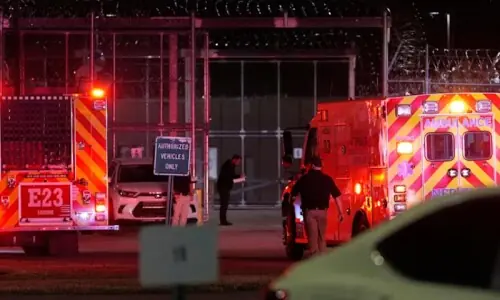
THE murder in Kohat of Hafeezur Rehman, chief editor of a local weekly newspaper and the president of the cable TV network owners association, appears to be yet another chapter in the saga of violence against this country’s journalists.
While it may be too soon to authoritatively say that he was targeted as a result of his profession, this much is obvious: across the country, those whose duty it is to report on events regularly come under fire from extremists — and sometimes even by state-sponsored actors.
Further, the modus operandi of the attack on Hafeezur Rehman was the same as the one employed in the killing in Tank earlier this month of journalist Zaman Mehsud, responsibility for which was claimed by the banned TTP.
Also read: ‘More journalists killed in Pakistan than any other democracy’
Then, two weeks ago, Mohammed Afzal Mughal, vice president of the Balochistan Union of Journalists, was picked up by a law-enforcement agency; he was released the next afternoon, perhaps in part because his plight was immediately made public nationwide by the media.
And last week, the Faisalabad bureau office of Dunya TV was targeted with a hand grenade, leaving three people injured.
Not even a month has passed since the UN marked the International Day to End Impunity for Crimes Against Journalists on Nov 2.
The occasion was in Pakistan highlighted by most media houses that reiterated their call for the government and its justice system to forcefully pursue cases where media employees are harassed.
Yet the only two cases where the murders of journalists have seen pursuit and sentencing are those of Daniel Pearl and Wali Khan Babar, the former as a result of international pressure and the latter after much prodding locally.
The killing of Saleem Shahzad remains unresolved, to say nothing of cases where death has not been an outcome.
Until the state takes measures to end this culture of impunity, few media persons will be able to say that they can discharge their obligations the way they are supposed to.
Published in Dawn, November 24th, 2015