0
0


KARACHI: A few years ago, customs authorities saved 800 clay vessels from being smuggled into the international market. The confiscated pieces of pottery belonged to different parts of Balochistan, dating back from 4000 to 1900BCE. Subsequently, a Pakistan-German team of experts restored and assembled the vessels. An exhibition of more than 100 of those exhibits titled Lost and Found opened at the National Museum of Pakistan on Thursday evening.
It contains an eye-catching variety of pottery discovered from central, southern and southwestern regions of Balochistan. On view are single and large-sized bowls as well as smaller pieces put together to represent a certain time period. Among the single ones, in the far right corner of the exhibition hall, there is one bowl with a distinct fish scale pattern (3100-2800BC) on it. Discovered from central Balochistan, the organisers claim it is one of the biggest vessels on display. It shows three rows of big loops forming a fish scale pattern on a red base.
On its right is the Togau pottery (3500-3100BC) from the same part of the province. It is marked by highly-fired and thin-walled bowls with rows of running ibex ‘reduced over time to the depiction of their horns’.
It is interesting, and perhaps is a testimony to the experts’ diligent work, that the animal motifs on a majority of pottery works are in a pristine state, with neatly defined contours and shapes. The goats, bulls and ibexes prettily drawn on the vessels are quite striking to look at. It is quite astonishing that, in terms of execution, the kind of artistry and artisanship that was practised thousands of years ago is no less refined than contemporary art or the art produced in the last few centuries.
For example, in a piece titled ‘The Kulli and the Indus’ (2600-2000BC) from southern Balochistan, the viewer is told that the hallmark of the pottery from that era is the bull-in-front-of-a-tree motif. It is an intriguing exhibit which comes across as an artwork that tells a story, provided the viewer is willing to lend an ear to it.
And, of course, there’s Nal Pottery (3100-2800BC) from central Balochistan, named after the site of the first discovery, having figurative motifs and polychrome decoration.
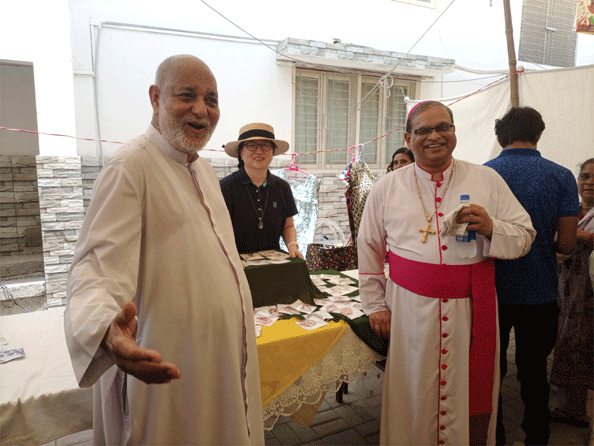
The exhibition has been jointly organised by the German Consulate, the government of Sindh, the National Museum of Pakistan and the Museum of Islamic Art — National Museum Berlin.
Published in Dawn, November 20th, 2015