KARACHI: While Pakistan and India failed to grasp a historic opportunity to resolve their long-festering disputes — particularly Kashmir — during Pervez Musharraf’s rule of this country, New Delhi and Islamabad should build on the framework achieved during this period and take it forward.
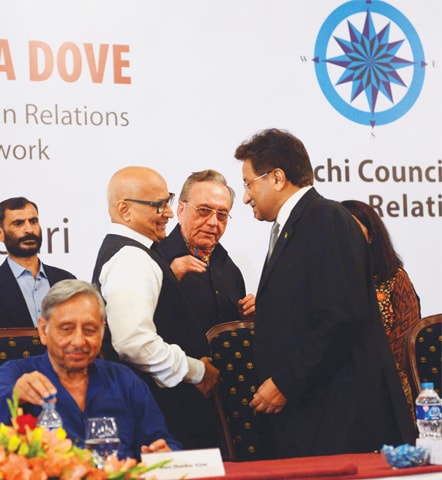
This was the common thread highlighted by most speakers at the Karachi book launch on Monday of Neither a Hawk nor a Dove, written by former foreign minister Khurshid Mahmud Kasuri, who served during Mr Musharraf’s rule. The event, held at a local hotel, featured a distinguished panel, including the former military ruler as chief guest, as well as speakers from India, including Sudheendra Kulkarni, Mani Shankar Aiyar and Salman Haidar.
Also read: Kulkarni worse than Kasab, says Shiv Sena
Moreover, Mr Kulkarni — who was infamously doused with black paint by Shiv Sena thugs for hosting Mr Kasuri’s book launch in Mumbai last month — highlighted the fact that “we in India must de-demonise Mohammad Ali Jinnah and recognise him as a great humanist and great leader. Pakistanis should [also] see Gandhi, Nehru and [Abul Kalam] Azad in the true, objective perspective.”
There was barely a vacant seat in the packed hall as retired general Musharraf was led in, surrounded by a legion of security men, receiving a standing ovation from the crowd. The former military president remarked that in the period when Mr Kasuri served as foreign minister — 2002 to 2007 — “Pakistan had optimised its power potential. Foreign policy success is directly proportional to domestic performance. Through internal strength we created the environment to perform abroad”.
Speakers call for building on Musharraf-era framework at book launch ceremony
Coming to the Pakistan-India relationship, Mr Musharraf was emphatic when he said that “never have India-Pakistan relations been as good as they were in our time. Never have all disputes been so close to resolution than in our time. Sir Creek was demarcated by both navies. The lines to be drawn at Siachen were ready. I regret that we were so close yet so far.”
Pervez Musharraf praised Atal Bihari Vajpayee and Manmohan Singh for being “sincere for peace”. However, while referring to 1999’s Kargil debacle, the former general said that “it was a military victory converted to a political defeat”.
Mr Musharraf also observed that Mr Kasuri’s book “clarified the misconceptions” that the Pakistan Army was opposed to peace with India. “The army is for peace with India, but with honour, dignity and sovereign equality.”
‘Uninterruptible dialogue’
Mr Kulkarni, head of the Observer Research Foundation, who also received a standing ovation, paraphrasing fellow panellist and former Indian petroleum minister Mani Shankar Aiyar, said there should be “uninterrupted and uninterruptible dialogue” between Pakistan and India.
He recalled that he had accompanied L.K. Advani to Karachi 10 years ago; the senior BJP leader had paid tribute to the Quaid-i-Azam, which resulted in a controversy erupting in India. “He paid a heavy price,” Mr Kulkarni remarked.
He said Kashmir was indeed an issue and that “it must be addressed in a just and honourable manner that satisfies the suffering people of Kashmir. How can we have a permanent military presence in the beautiful state of Kashmir?”
He added that he hoped Indian Premier Modi “does not reinvent the wheel” with reference to Pakistan-India relations and that “useful homework had been done” where resolution of Kashmir was concerned. Mr Kulkarni said terrorism and religious extremism were common threats to both countries. “Let’s cooperate to remove the threat.”
Mani Shankar Aiyar said it was “disturbing” that the Indian government, as well as two successive governments in Pakistan, had failed to acknowledge the agreements from the Musharraf-Kasuri days. “All this would have disappeared if Khurshid had not written the book.”
Referring to the reluctance by some in India to deal with military-led governments in Pakistan, Mr Aiyar said “several issues have been resolved when the military was in power in Pakistan.” He said it is for the people of Pakistan to decide who should be in power and “we [Indians] have to deal with whoever is in power here”.
Referring to the potential of dialogue, the former minister said that while the Americans were bombing North Vietnam mercilessly in 1972, representatives from both sides continued negotiations in Paris, which led to an agreement. “We have differing perceptions but the path of dialogue can lead to reconciliation.”
Former Indian foreign secretary Salman Haidar observed that dialogue had been interrupted and can be interrupted. “Questions such as ‘is dialogue a concession to the other side?’ are raised. [Dialogue] is not an automatic process. It requires continuous endorsement.”
He praised Mr Kasuri for writing on secret processes “without letting the cat out of the bag”.
Earlier Khurshid Kasuri made the opening remarks while Ameena Saiyid, head of OUP, which hosted the event, gave the welcome address.
Published in Dawn, November 3rd, 2015
On a mobile phone? Get the Dawn Mobile App: Apple Store | Google Play