ISLAMABAD: The Pakistan Army has emerged as the most trustworthy institution in the country, a survey carried out by the Pakistan Institute of Legislative Development and Transparency (Pildat) said Tuesday.
The same survey recognised Prime Minister Nawaz Sharif as the most popular political leader in Pakistan with an approval rating of 75 per cent.
A review of the current leadership of the country shows that the people of Pakistan have contrasting views on the most trustworthy leaders in the country.
The results have been released from a two-part survey covering separately the quality of governance and democracy.
The survey was first conducted upon the completion of the first year of the national and provincial assemblies and the government in office in May 2014.
The nationwide poll was conducted again from June 2 to 12, 2015, following the completion of the second year of the assemblies and the government.
Institutions
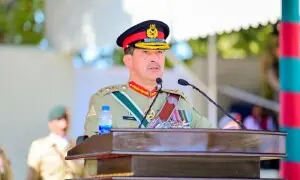
The survey shows that Pakistan’s Armed Forces are leading as the most trustworthy institution, with an approval rating of 75pc.
Similarly, the Supreme and High Courts of Pakistan earned a strong approval Rating of 63 per cent, the print and electronic media 55pc and 54pc respectively, the National Assembly was characteristic of an approval rating of 49pc, followed by the civil courts at 43pc and the Election Commission of Pakistan (ECP) was able to earn an approval rating of 37pc.

The respondents for the survey included 3,231 citizens from rural and urban areas from all the four provinces, including various age, income, education and language groups of the population.
Political parties
The Pakistan Muslim League-Nawaz (PML-N) had the highest approval amongst the population, with 70pc of the respondents rating the party’s competence highly. The Pakistan Tehreek-i-Insaf (PTI) followed with an approval rating of 44pc. The Jamaat-e-Islami (JI) and the Pakistan People’s Party (PPP) were approved of by 40pc and 36pc of the respondents respectively.
In contrast, all other political parties included in this poll generated relatively lower approval levels of their competence. At the end of second year of the survey, the Muttahida Qaumi Movement (MQM) emerged as the most negatively rated political party in the country with an approval rating 14pc.
Dr. Tahir-ul-Qadri’s Pakistan Awami Tehreek (PAT) received a relatively low rating at 19pc, the Awami National Party (ANP) was favourably voted for by 21pc and the Jamiat Ulema-e-Islam- Fazl (JUI-F) had only slightly higher rating at 23pc.

High-scoring core democracy indicators
At the completion of the second year of the current Parliament and Provincial Assemblies, 66pc of the respondents approve of the overall quality of democracy in Pakistan.

Low Scoring Core Democracy Indicators

Others
A substantial 80pc of the respondents say that holding local government (LG) elections nationwide are somewhat to very important while only 11pc believe that holding these elections is not very important or not important at all, the survey showed.
As many as 59 per cent of the respondents believed that the elections 2013 were somewhat to completely transparent and fair.
On the contrast, 30 per cent of them saw the polls as somewhat to completely rigged. For the democracy survey conducted at the end of the first year of the elected government, 53 per cent of the respondents believed that the 2013 election were completely to somewhat transparent and fair and 37 per cent thought they were somewhat to completely rigged.