|
| Malaysia’s Prime Minister Najib Razak.—AFP |
KUALA LUMPUR: It’s Malaysia’s $700 million question: who transferred massive amounts of cash into Prime Minister Najib Razak’s personal bank accounts, and where is the money now?
But with Najib refusing to answer and concern that investigations have been stalled, thousands of protesters plan to demand his ouster this weekend, putting them on a potential collision course with police.
The demonstration could expose the breadth of public anger over Malaysia’s biggest political scandal in memory.
The Wall Street Journal’s revelation last month of Najib’s mysterious windfall has rocked his government and sent foreign investors fleeing Malaysian assets over the potential political uncertainty.
“You will see a sea of yellow in the streets this weekend,” said Wong Chin Huat, a leader of civil society alliance Bersih, referring to the group’s colours. “People realise the country and economy are in a sad state and it’s being brushed aside by the government.”
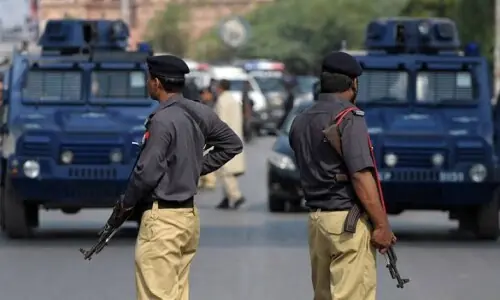
Malaysia’s leading pressure group has brought out tens of thousands for past demonstrations that ended in clashes with police, most recently in 2012. Police have declared the rally illegal, but Wong said at least 100,000 people are expected to press for Najib’s ouster over the scandal in the two-day rally.
“By hook or by crook, we will march,” he said.
‘Political donations’
Malaysians have been transfixed by months of allegations that hundreds of millions of dollars disappeared from deals involving heavily indebted state investment company 1Malaysia Development Berhad (1MDB), which Najib launched in 2009.
On July 2, the Wall Street Journal reported that nearly $700m was deposited into Najib’s personal bank accounts beginning in early 2013.
Najib initially rejected the Journal report, and both he and 1MDB vehemently deny any wrongdoing.
But members of his cabinet and Malaysia’s anti-graft agency now acknowledge the transfers, calling them “political donations” from unidentified Middle Eastern sources, saying there was nothing improper but giving no further details.
The accounts have since been closed and the whereabouts of the money is unknown.
The official explanations are widely rejected by the public, said Malaysia politics researcher James Chin.
“Najib’s credibility is destroyed. None of these explanations are believed, so he is digging his heels in,” he said.
Alleging a “political conspiracy” by unnamed opponents, Najib recently sacked or reassigned officials who were investigating the scandal, and purged cabinet members who called for answers.
A newspaper known for its 1MDB reporting has been suspended for three months and Najib last week sparked free-speech concerns by saying his government would step up internet regulation.
This was to prevent anyone “being criminally defamed, and so that the internet does not become an ungoverned space dominated by insults and untruths,” he said in a speech.
Najib’s office did not respond to AFP requests for comment.
Economic ‘crisis’ looming
The situation has accelerated an exodus by foreign investors already worried about Malaysia’s economy who now fear the scandal is dominating Najib’s attention, said Chua Hak Bin, head economist for Asian emerging markets at Bank of America Merrill Lynch.
“The government is focused on [political] survival, but the economy is in danger of slipping into crisis as a result,” said Chua. “Investors can’t see the endgame, and that’s worrying.”
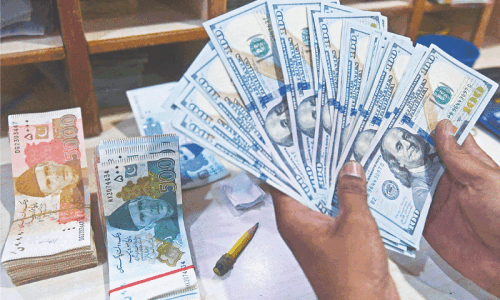
The ringgit currency has fallen 13 per cent since the Wall Street Journal revelations. It has dropped more than 30pc over the past year to an 18-year low, partly on fears the energy exporting country’s economic growth will be hit by faltering oil prices.
China’s recent currency devaluation has added further pressure.
Mahathir Mohamad, who led Malaysia from 1981-2003 and still casts a long shadow, has fiercely attacked Najib over the scandal.
He warned on his widely read blog recently that the “economy will collapse”, harming Malaysian consumers, unless the scandal is explained and confidence restored.
Political analysts say Najib will likely use his government’s leverage over key institutions to thwart investigations. He is expected to see off any internal challenges within his ruling United Malays National Organisation (UMNO).
Less clear is the impact on the next elections, which are due by 2018.
In power since 1957, the government is already losing support over recurring corruption scandals, and UMNO’s use of racially divisive politics.—AFP
Published in Dawn, August 27th, 2015
On a mobile phone? Get the Dawn Mobile App: Apple Store | Google Play