0
0

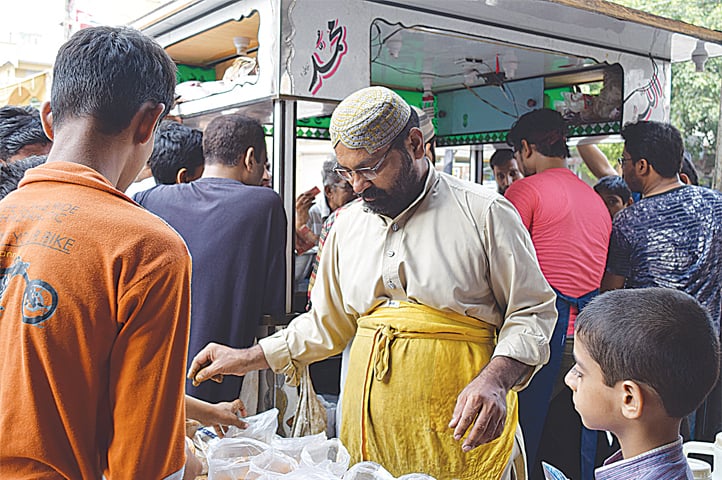 |
| Sibtain and Shehroze divide responsibilities: one packs dahi baray and the other handles the yoghurt mix, Photos by the writer |
Blaring sirens are usually taken as a sign of an emergency — in Karachi’s largely Shia-dominated Ancholi area, perhaps a siren is needed to tell residents, Ancholi Dil Pasand Chaat is open for business.
Commonly known as ‘Shahid ki chaat’ or ‘Shahid’s chaat’ by dwellers of the area, the original owner’s grandsons, Sibtain and Shehroze, now stand by their four-wheel wooden cart with a plastic-metallic structure erected over it bearing the name. Legend has it that the venture goes back to the time when early settlers came looking for a place to live after Partition, ideally in a community to feel close to home, bearing semblance to all that they left behind.
But the vendors themselves date the venture about 40 years ago. “It all started in 1978, when our grandfather Muhamad Ismail had set up a thela (pushcart) to sell chola chaat,” says Sibtain, who has aides by his side adding to his story.
Many confuse the delicacy with channa chaat, but Shahid’s chaat is no ordinary chaat. It breaks from tradition and the mixing of finely chopped onions, green chillies and tomatoes served with flour-based papar or crackers. “Unlike other channa chaat or cholas, we keep it simple with basic chutneys and chickpeas, which we boil at home,” explains Sibtain.
Despite business increasing manifold at Karachi’s Ancholi Dil Pasand Chaat in Ramazan, there is still only a three-hour window to buy chola chaat before their stock runs out
A plate of Shahid’s Chaat, ideally for one person, costs Rs50, and at least 100 customers buy chaat from the pushcart, with a majority taking away more than two or even five plates to their homes.
But ask him about his recipe, and it appears that Sibtain and his colleagues are pros at dodging questions about the procedure about making the basic ingredients.
“The reason why we are still going strong is that we prepare all the basic ingredients at home, we have a meethi (sweet) chutney, a khatti (sour) chutney, semi-sweet yoghurt and our own dahi baray made from daal to create the perfect plate,” says Sibtain. Some customers gathered around the pushcart tell how they’ve tried making it at their homes and fail to get the taste of the chaat sold there.
Meanwhile, the clamour and commotion around their stall has grown palpable: while there are long, winding queues around the pushcart, the owner takes a small, transparent plastic bag, swiftly pours different coloured sauces over chickpeas, tosses a white liquid, drops in something soft and gooey, sprinkles crispy, brown crackers over it and finally ties the contents with a pale rubber band before handing it out.
Its popularity can be gauged from its famous two to three hour window — as soon as the sons arrange their cart at 5pm, customers start to hover around them as their three helpers, needed only in the holy month, divide tasks amongst themselves, with one breaking up papri into tiny pieces, one handling the payments and the other handing over the plastic bags depending on the number of plates ordered.
 |
| Photos by the writer |
“We get more than a 100 customers each day, and in this month, our sales are two to three times more. Of course, the profit margin increases in Ramazan, but to give an exact figure is difficult because it varies every day.
Within one-and-a-half hours, all that remains before Sibtain and Shehroze is the white milky yoghurt in the vat placed before them — the papri, chickpeas and chutneys have all ended. Many customers try convincing them to sell the chaat but to no avail — Sibtain plainly refuses all, men, women and children.
I can assure you that the profit we make is always three to four times more than our investment, by the grace of the Almighty.”
With demand already high, Shahid’s grandsons refuse any bulk orders and are content with their sales. While many small businesses in the area have a private or government job by their side, the two sons looking after their family business focus solely on their chaat.
Their humility is also embedded in their lived realities.
“While they sell their chaat from 5pm to around 7pm in Ramazan, in other days the timings shift from 6pm to 9pm,” explains an old friend of Sibtain, who has grown up in the area. “On the fateful night of Nov 22, 2013, as both brothers winded up their business and had just headed back to their homes, Ancholi was rocked by two blasts, hardly a few feet away from their stall. Needless to say, their cart was destroyed. Despite multiple claims by the government authorities to reimburse, nothing was granted to them. We were just thankful that they didn’t lose their lives like those 10 young men.”
But that incident didn’t break their spirit and the brothers were back again with their chaat as all those people who resumed their businesses like before.
Within one-and-a-half hours, all that remains before Sibtain and Shehroze is the white milky yoghurt in the vat placed before them — the papri, chickpeas and chutneys have all ended. Many customers try convincing them to sell the chaat but to no avail — Sibtain plainly refuses all, men, women and children.
Chewing on his paan, Sibtain faces a hard time talking as he refuses a lady who insists on getting one plate only. “The chaat is not only popular in this area, rather people from all over the city come to have a go at it with their orders getting doubled in Ramazan. Be it Defence, Jauhar or even Mauripur, our chaat has its loyal customers in all corners,” he says with pride.
As Iftar time nears, Sibtain’s helpers start cleaning the place.
“Though we are not married as yet, we would want our children to get a good education and work in decent firms. I can’t see my kids selling chaat.” Many tell him that he would deprive so many of the one-of-a-kind chaat in town, but he just smiles forlornly.
When asked about the details of who does most of the work or the small chores like bringing the daily bags, preparation of chutney or mixing huge quantities of yoghurt, Sibtain now visibly irked by the question points at individuals stating that everyone works very hard and brilliantly on the job they are supposed to perform.
His old friend who is eying him closely laughs and tells how he wasn’t able to marry a girl who used to love the chaat because she left him saying that he was just another chaat wala. Not sure about the love tale but this chaat definitely has a reputation with food lovers.
The writer tweets @AnwerNaqvi
Published in Dawn, Sunday Magazine, July 19th, 2015
On a mobile phone? Get the Dawn Mobile App: Apple Store | Google Play