0
0
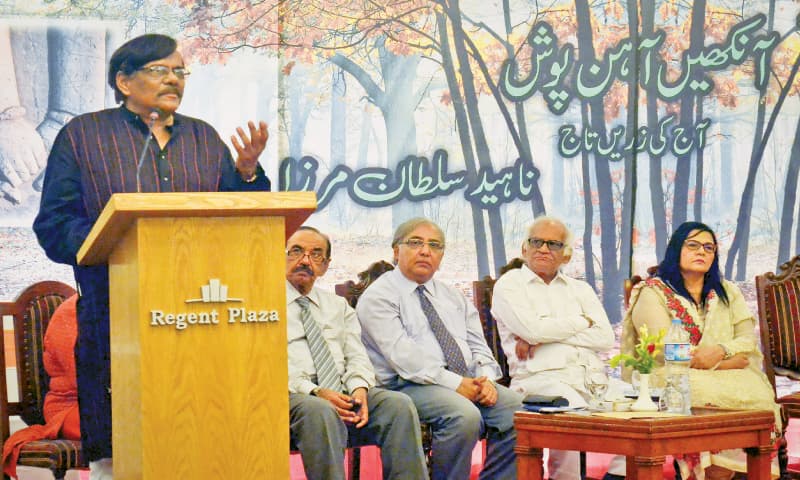

KARACHI: The story of this novel is a kind of feminist protest against the horrors of war. The characters put forth the argument that it is the women who get affected most by wars. This was said by renowned Indian novelist and former vice chancellor of the Mahatma Gandhi Hindi University Vibhuti Narain Rai while presiding over the launch of Urdu novel Aankhein Aahan Posh by Naheed Sultan Mirza at a local hotel on Tuesday night.
Mr Rai said a few months back when he received some pages of the novel he developed an interest in it. He said the novel told the tale of three generations of women based in Iran, which meant it delineated a particular period of time spanning 70 to 80 years. He argued that although one of the subjects of the book was the Iranian revolution, there were other important aspects in it which enabled the reader to understand society at large. He said he had read the book in bits and pieces and would like it to be translated into Hindi so that it reached a wider audience.
Speaking on the ‘feminist angle’ of the story, Mr Rai said it made us think about the hazards of war highlighting the point that it’s the women who got affected most by wars.
He pointed out that since India and Pakistan had fought a couple of wars, the people of the region were in a better position to understand that. He commented that in literatures written in the subcontinent there were not many memorable female protagonists but Aankhein Aahan Posh had three characters which would be remembered for a long time. He said that these days literature had become one of the major sources of history.
Vice Chancellor of Ziauddin University and eminent poet Dr Pirzada Qasim, who was the chief guest on the occasion, said whatever goals Naheed Sultan Mirza set for herself, she accomplished them with great responsibility. She began her writing career as a journalist where she performed her duties with utmost seriousness and without any compromises. As a novelist, it was her perfectionism that was very impressive, he said. On the content of the book and referring to the Iranian revolution, he said, “When things don’t settle after a revolution has taken place, problems begin to surface.” And that’s what the author had tried to draw her readers’ attention to, he added.
Prof Sahar Ansari said Naheed Sultan Mirza started her career as a journalist and took active part in the 1978 movement for freedom of the press. She had in her what it took to be a novelist, and therefore the novel, her second, wasn’t written in haste but a lot of thinking had gone into it. Shedding light on the three main women characters in the book, he recalled real life greats like Qurrutulain Tahira, who became symbolic for Naheed Sultan Mirza’s story. He claimed that the novel was one of historical consciousness.
Naheed Sultan Mirza read out an excerpt from the book.
Writer Zahida Hina said the 1979 revolution in Iran influenced many writers, including Qurrutulain Hyder, but one of her stories in that context couldn’t reach a larger readership due to a number of reasons. She called Aankhein Aahan Posh a docu novel which had described the bloody battles between the past and the present, the old and the new, in the post-1979 period.
Writer Muslim Shamim said the novel reminded him of Qurrutulain Hyder’s Aag Ka Darya. It provoked the reader into asking questions, and though it had three women as its lead characters, it encapsulated issues faced by humanity.
Dr Syed Jaffer Ahmed said in terms of plot, technique and locale the novel was a fresh addition to Urdu literature. It was spread on three canvases — of time, space and meaningfulness — where Iran was its main locale.
Indian poetess Vandna Mishra said the fact that the book quoted a Rumi poem indicated its all-inclusive approach to life. It had an optimistic tone, she added.
Saba Ikram said Naheed Sultan Mirza’s first novel was based in Iraq and this one in Iran, spanning three generations.
Published in Dawn, June 10th, 2015
On a mobile phone? Get the Dawn Mobile App: Apple Store | Google Play