ISLAMABAD/RIYADH: Prime Minister Nawaz Sharif and Saudi King Salman Bin Abdul Aziz held a luncheon meeting at the Royal Palace in Riyadh on Thursday, where Nawaz expressed “solidarity” with Saudi Arabia after Pakistan's parliament refused to send forces to help a Saudi-led coalition in Yemen, a Pakistani official said.
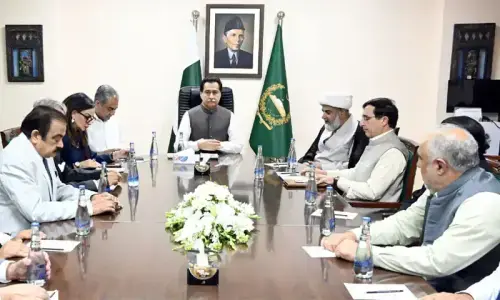
Nawaz Sharif arrived with a powerful delegation including army chief General Raheel Sharif and Defence Minister Khawaja Asif, who met King Salman and other top government officials.
“The main focus was for solidarity with Saudi Arabia” in line with earlier commitments from Islamabad to defend the kingdom's territorial integrity, the official told AFP.
During the meeting, the PM also told the Saudi leadership about the measures Pakistan had taken to implement the United Nations Security Council resolution on Yemen.
Sharif also welcomed shared proposals for peace and stability in the region.
Later, delegation-level talks between Pakistan and Saudi Arabia were also held at the palace.
Prime Minister Nawaz Sharif led talks from the Pakistani side, while the Saudi delegation was headed by King Salman bin Abdul Aziz.
Nawaz Sharif also held meetings with Saudi Crown Prince Muqrin bin Abdul Aziz and Deputy Crown Prince Muhammad bin Naif at the Royal Palace.
Earlier in the day, Prime Minister Nawaz Sharif, along with his delegation, had arrived in Riyadh on a daylong visit.
He was accompanied on his visit by Minister for Defence Khawaja Muhammad Asif, Chief of Army Staff General Raheel Sharif, Special Assistant to PM Mr Tariq Fatemi and Foreign Secretary Mr Aizaz Ahmed Chaudhry.
The premier, along with his delegation, was accorded a warm welcome by Saudi Defence Minister Prince Mohammad bin Salman at Riyadh air base.
Nawaz also held a consultative meeting with his close civil and military aides on the Yemen situation in his special jet.
A senior Pakistan diplomat had told DawnNews that soon after arrival, PM and his delegation would proceed to Royal Palace where they would meet the Saudi king.
The decision to visit Saudi Arabia was made yesterday at a high-level meeting chaired by the PM to discuss the crisis in Yemen.
Read: Army chief, PM Nawaz to depart for Riyadh tomorrow
A source privy to preparations for the trip said that the purpose of a joint visit by the civil and military leadership was to reassure the Saudis that Pakistan remained fully committed to Saudi Arabian security.
The trip is aimed at limiting the damage caused by Islamabad’s wavering over the issue of committing troops for the Saudi-led offensive against Yemen’s Houthi rebels.
The visit is taking place at a time when Saudi Arabia announced an end to the Operation Decisive Storm in a move towards the start of the political dialogue for settlement of the dispute. Pakistan has welcomed the halting of air strikes by Saudi Arabia.
Saudi Arabia had expected Pakistan’s active involvement in the military coalition. The government first referred the matter to a joint sitting of the Parliament, which after five days of debate came up with a call for neutrality.
The parliamentary resolution provoked strong reaction across the Arab world and the prime minister had to personally issue a statement reassuring the Arabs that his government continued to stand by their side and later dispatched his brother Punjab Chief Minister Shahbaz Sharif as a special envoy to clear the misgivings and pledge assistance for enforcing the UN Security Council’s arms embargo on Houthi rebels and forces loyal to Ali Abdullah Saleh.
But that was not enough to pacify the annoyed royal Saudi family.
The combined visit by PM Sharif and Gen Sharif, a Pakistani diplomat said, would carry a lot of symbolism as well.
“The Saudis were particularly perturbed over not physically seeing Pakistanis on their side. This visit will address that perception and convey to the regional actors in the clearest terms that Pakistan stands by Saudi Arabia,” he added.
The two sides, a source from Riyadh said, could come up with an arrangement that could serve as a consolation for not joining the military coalition when the Operation Decisive Storm had been started.
A Pakistani official insists that whatever is agreed in Riyadh would be in conformity with the parliamentary resolution – which has a lot of room for interpretation.